Verdict
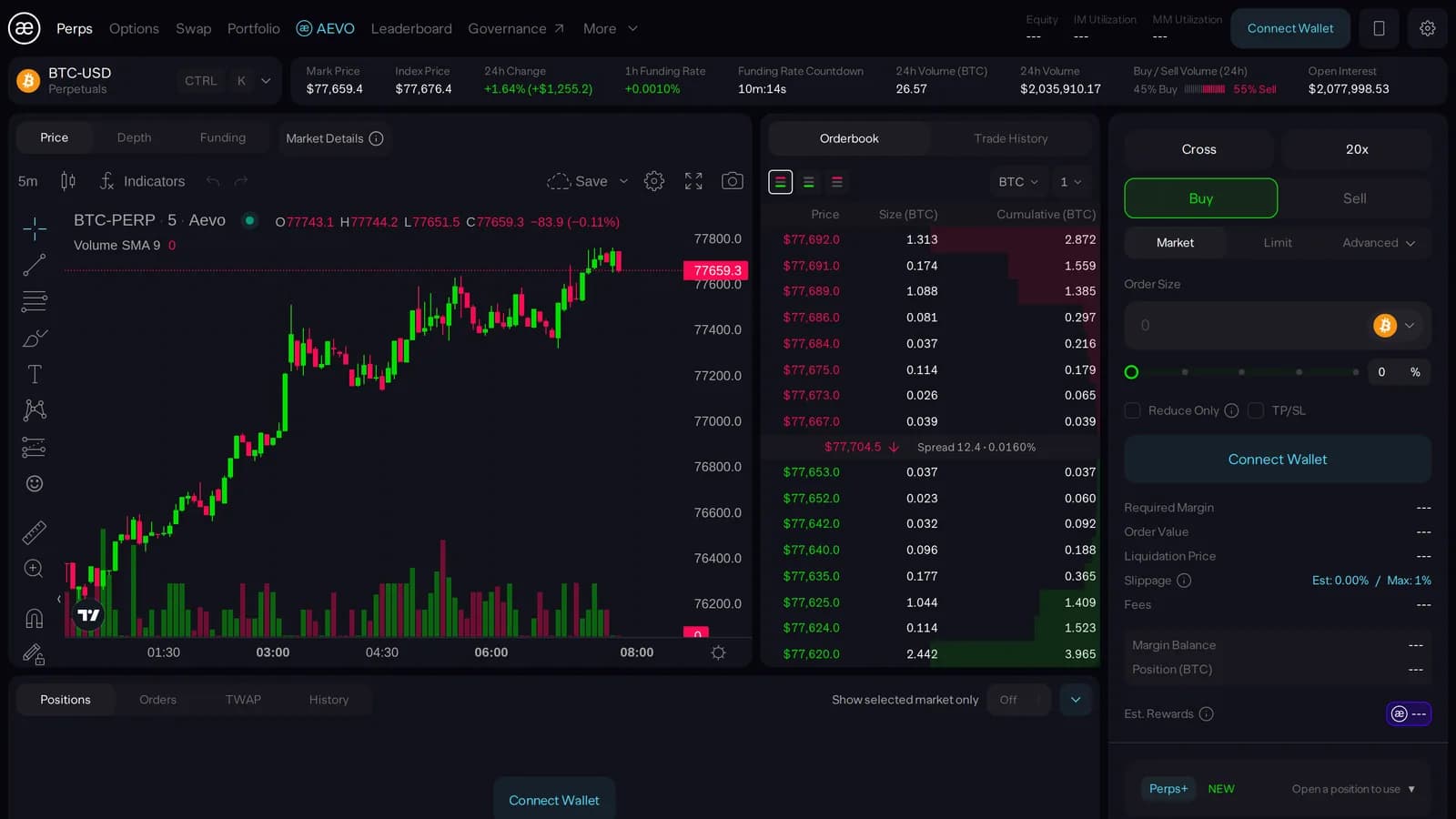
Aevo runs an off-chain order book with on-chain settlement on its own rollup, and offers options and pre-launch futures that nobody else does. The options liquidity is thin enough that the surface is more interesting than tradeable.
- Best for
- Pre-launch futures and small options positions
- Cost
- 0.03% options taker, 0.05% perp taker
What works
- One of very few venues offering on-chain options at all
- Pre-launch futures give exposure to tokens before they list anywhere
- Settlement is on-chain and margin is self-custodied
- Unified margin across options and perpetuals in one account
What does not
- Options books are thin; quoted spreads on the wings are wide
- Matching happens off-chain, so the decentralisation claim is partial
- Pre-launch futures are structurally easy to manipulate
- Volume is concentrated in a handful of markets and campaigns
Options are the hardest derivative to build on-chain. You need a continuous surface across strikes and expiries, market makers willing to quote it, and a margin system that understands the positions are related to each other. Almost nobody has managed it. Aevo has, up to a point, and the point is liquidity.
The architecture
Orders are matched off-chain on Aevo's own infrastructure, then settled on an Ethereum rollup where positions and collateral live. You keep custody of margin; the matching engine is operated by the team.
That is a reasonable engineering compromise — a fully on-chain options book would be unusably slow and prohibitively expensive to quote — but it should be described accurately rather than marketed around. This is a centralised matching engine with decentralised settlement, and if the operator stops, quoting stops with it. What you keep in that scenario is your collateral, which is not nothing.
Fees
Options taker fees sit around 0.03% of notional with a premium-based cap in the same spirit as Deribit's, and perpetual takers pay around 0.05%. On paper this is competitive with the category leader.
On paper is doing a great deal of work in that sentence. A 0.03% fee against a 6% bid-ask spread on a mid-dated option is a rounding error — the spread is your real cost, and on Aevo's wings it is wide enough that a round trip can cost more than a sensible position's expected profit.
Unified margin
Options and perpetuals share one margin account, so a hedged position is charged for the net risk rather than each leg separately. For anyone running a covered or delta-hedged structure, this is the feature that makes the venue usable at all, and it is implemented properly.
Pre-launch futures
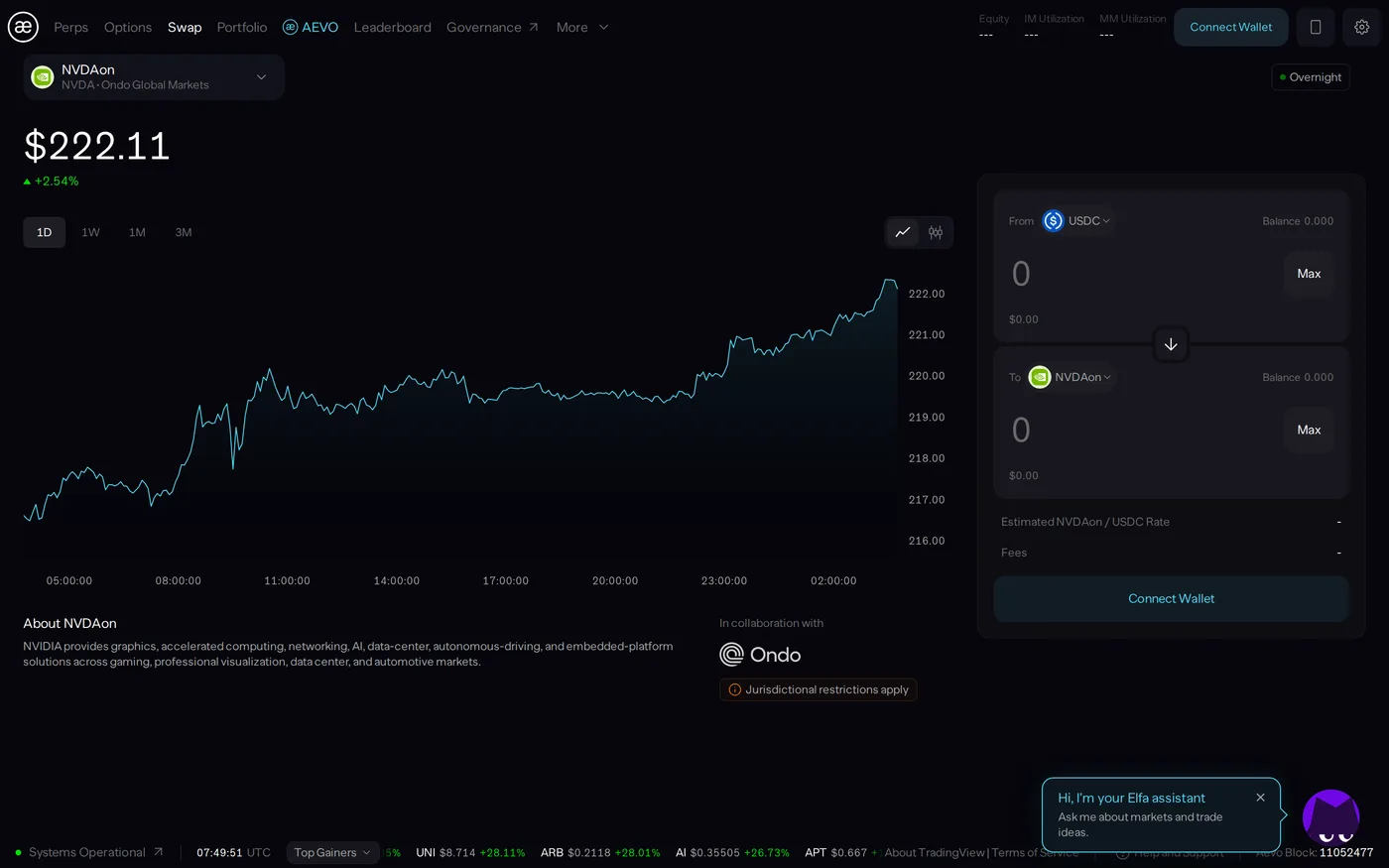
Aevo lists futures on tokens that have not launched yet, settling once the token begins trading. This is a genuinely novel product and it fills a real gap: price discovery before listing currently happens in private OTC chats between people you are not in.
It is also structurally fragile. There is no spot market to anchor the price, so the contract trades purely on sentiment until settlement, and a determined participant with size can move it a long way with no arbitrage force pushing back. Treat these as a speculative product with manipulation risk priced in, not as a hedging instrument, and size them as you would size a bet.
A futures contract with no underlying spot market is a prediction market with a leverage slider. Neither of those words is a criticism, but both of them should change your position size.
Who it suits
Traders who want small on-chain options positions and can accept the spread as the cost of self-custodied settlement.
Anyone specifically seeking pre-launch exposure, with position sizes they can afford to lose entirely.
Users who need options and perpetuals to net against each other inside one margin account.
Verdict
How to tell whether a thin options market is tradeable
Look at the bid-ask spread as a percentage of the mid price, not in dollars. A 30-cent spread on a $4 option is a 7.5% round trip.
Check whether there is a bid at all on the strike you want, not just an ask. You will need to close the position eventually.
Compare the implied volatility against the same strike on Deribit. A large gap is a liquidity premium, not an opportunity.
Size so that you could accept the worst fill visible on the screen today, because that is the fill you will get when you need to exit.
Applied honestly, that checklist rules out most of Aevo's options book for most position sizes. It also identifies the handful of near-dated at-the-money strikes where the venue is genuinely competitive, and those are worth trading.
The rollup and what custody means here
Collateral sits on an Ethereum rollup in contracts you can inspect, and withdrawal is a chain operation rather than a request to a company. If the matching engine stopped permanently, the recovery path would be on-chain and the assets would still be yours.
That is a meaningfully better failure mode than a centralised options venue, and it is the main reason to tolerate the liquidity. You are not choosing between Aevo and Deribit on execution — you are choosing on what happens if the operator disappears.
Score: 6.6. Interesting, well-built, and too thin to recommend for size. If you want optionsliquidity, Deribit is the answer and it is not close. If you want options with self-custodied settlement, this is one of the only answers available — which is the reason to keep watching it rather than to fund it heavily today.