Verdict
An NFC smart card with a certified secure chip that generates keys it will never export. The no-seed-phrase design removes the most common way people lose funds and replaces it with a different one: lose all your cards and it is over.
- Best for
- Simple cold storage without seed-phrase management
- Cost
- 2-card set ~$55, 3-card set ~$70
What works
- Certified secure element that never exports the private key
- No seed phrase to photograph, type into a phishing site or lose
- Card format survives water, drops and a wallet pocket
- Cheaper than every screen-equipped hardware wallet
What does not
- No screen, so you verify transactions on the phone — a weaker trust path
- Losing every card in the set means permanent loss with no recovery
- Requires a phone with working NFC for every single transaction
- App-based confirmation means a compromised phone is a real risk
Most self-custody losses are not hacks. They are seed phrases written on a piece of paper that got thrown away in a house move, photographed onto a phone that later got compromised, or typed into a website that looked right. The seed phrase is simultaneously the recovery mechanism and the largest attack surface in the entire design.
Tangem's answer is to not have one.
How it works
A Tangem card contains a certified secure element that generates a private key on first use. The key never leaves the chip — there is no export path, no display of twelve words, nothing to write down and nothing to photograph.
Backup is physical redundancy rather than cryptographic backup: you buy a set of two or three cards, and at setup they share the same key material. Keep one at home and one somewhere else. To sign a transaction, you tap a card against your phone.
What this actually trades away
The screen. On a Ledger or a Trezor, the transaction details appear on a display the device itself controls, and a compromised computer cannot change what you see there. That independent screen is the core of the hardware wallet security model — arguably it is the entire model.
Tangem has no screen. You read the transaction on your phone, in the Tangem app. If the phone is compromised, the address you are approving may not be the address you are seeing — which is precisely the class of attack that took $1.5 billion out of a Safe multisig in 2025, executed against signers who were using hardware.
Removing the seed phrase removes the most common failure. Removing the screen reintroduces the most expensive one.
The backup model
The card set is created once. You cannot add a card to an existing set later, so decide on two or three at purchase.
Cards can be reset and reused, which also erases the keys on them permanently.
Lose every card in the set and there is no recovery path. None. Not from Tangem, not from anywhere, not for any amount of money.
For some users that finality is a feature: no seed means no phishing target, no coercion lever, no accidental disclosure to a cloud backup. For others it is an unacceptable single mode of failure. Know which you are before buying, because the decision is not reversible after setup.
Cost and practicality
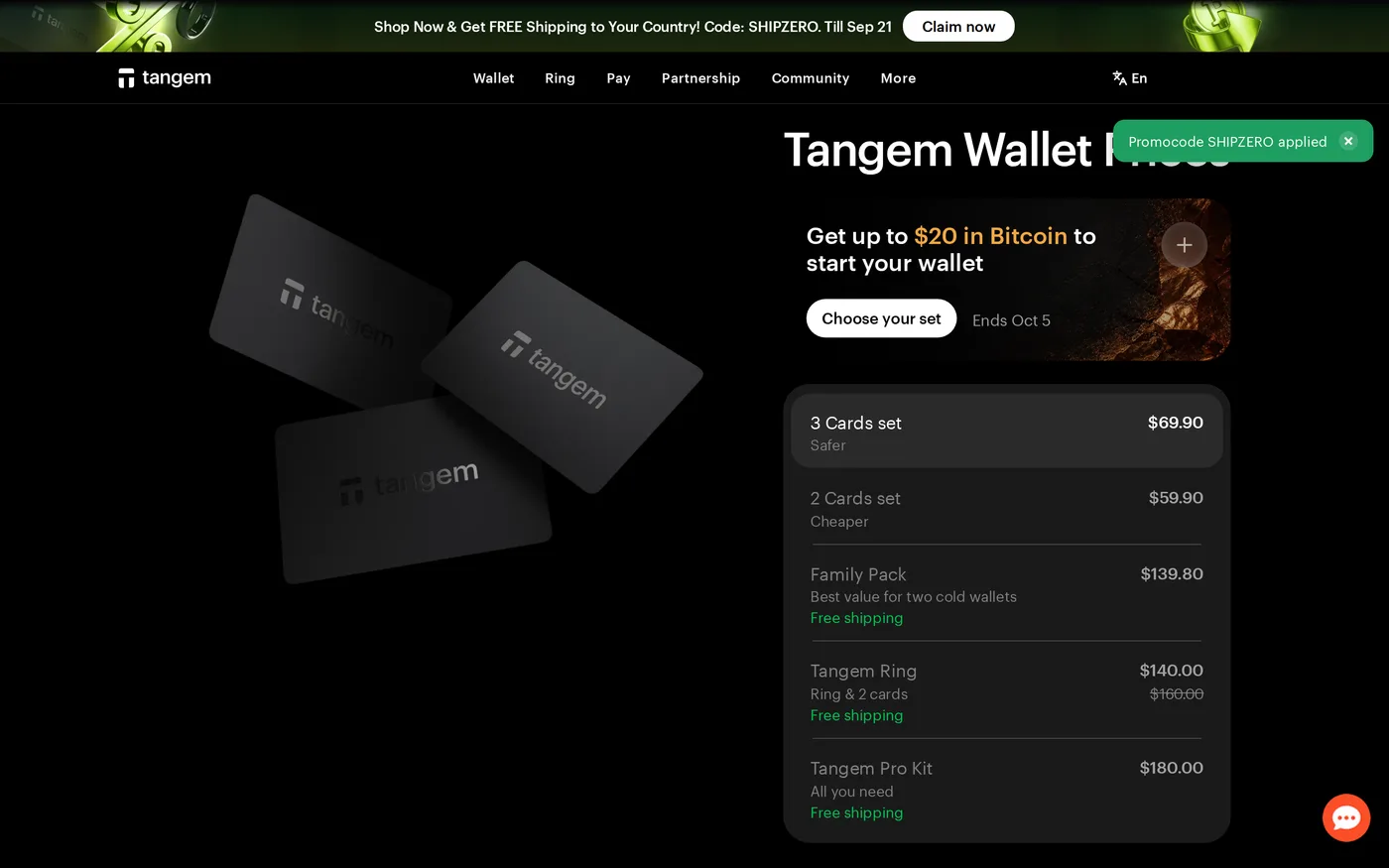
A two-card set is around $55 and three cards around $70 — cheaper than any screened device in this library. There is no battery to degrade and no cable to lose, and the cards survive being carried in a wallet in a way a Nano does not.
NFC is required for every transaction, which makes a working phone with NFC a hard dependency. If your phone dies, your wallet is inaccessible until you have another one, and if NFC is disabled or broken on the replacement, the cards are inert plastic.
How it compares
Against Trezor Safe 3: cheaper, simpler, and materially weaker on transaction verification. Against a hot wallet: dramatically better, because the key is genuinely not on the phone. Against nothing at all: the best $55 in this category for somebody who will not manage a seed phrase properly, and there are a lot of those people.
Verdict
The optional seed phrase
Tangem does support creating a wallet from a seed phrase if you want one, which restores compatibility with other wallets and gives you a familiar recovery path.
Doing that discards the main reason to buy the product. You now have a seed phrase to protect, plus cards, plus a screenless verification path — the worst combination of both designs. Choose the seedless model and accept its finality, or buy a device with a screen. The middle option is not a compromise, it is the union of both sets of weaknesses.
Practical setup
Buy the three-card set rather than two. The marginal cost is small and the third card is the difference between a lost card being an inconvenience and a disaster.
Store the cards in genuinely separate locations. Two cards in the same drawer is one card.
Set an access code on the cards so a found card is not a funded wallet.
Send a small amount, then verify you can move it back using a different card from the set before funding properly.
Score: 7.3. A genuinely thoughtful design that solves the most common real-world failure and accepts a weaker verification path to do it. Good for a straightforward long-term holding you will rarely touch. Not the right choice for someone signing complex transactions, where a device with its own screen remains the standard.