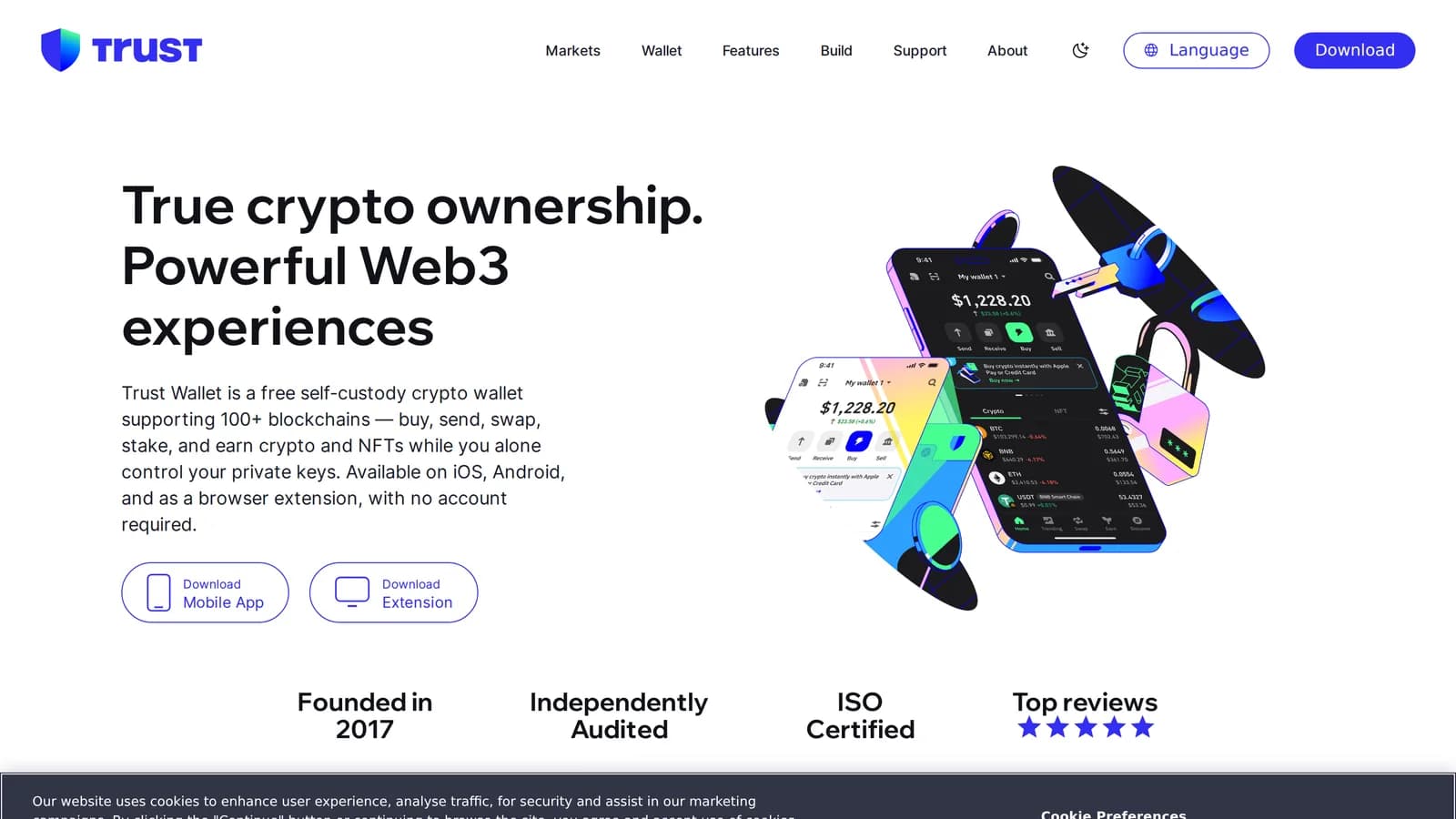
Verdict
Supports more chains than almost anything else and makes mobile self-custody genuinely approachable. The in-app swap and buy flows carry markups, and the breadth means the token list fills with things nobody vetted.
- Best for
- Mobile multichain holders
- Cost
- Free; markup on in-app swap and buy
What works
- Supports an enormous range of chains and tokens from one mobile app
- Onboarding is the most approachable of any self-custody wallet here
- Core libraries are open source and independently reviewed
- Built-in dApp browser works properly on mobile, which is rare
What does not
- In-app swaps and card purchases carry meaningful markups
- Automatic token display makes airdropped scam tokens look legitimate
- Ownership history via Binance leaves some users uncomfortable
- Desktop support is a later addition and less polished than mobile
Trust Wallet is the wallet you recommend to someone who has just decided to stop leaving coins on an exchange and is not going to read a guide first. Install, write down twelve words, done. The onboarding is the best in this category and it is not close.
Breadth
Chain coverage runs into the dozens, from Bitcoin and Ethereum through every major EVM network to Solana, Cosmos chains and a long tail beyond. For a holder with assets scattered across ecosystems, consolidating into one mobile app is a real quality-of-life improvement over running four wallets.
The dApp browser works properly on mobile — not a common achievement — which means WalletConnect is optional rather than mandatory for basic use, and the flow does not break when an application assumes a desktop extension.
The cost of the convenient paths
Swapping inside the app routes through providers with a markup, and buying with a card adds a payment-processor fee on top of an already wide spread. Neither is disclosed with the prominence it deserves, and both are the first thing a new user will reach for.
The wallet is free. The paths out of it are where the business is. Use it to hold and to sign; use an exchange or an aggregator to transact.
The scam-token problem
A wallet that displays every token sent to an address will display the ones sent to you as bait. They arrive with names imitating real projects, a price feed that shows an impressive fake value, and a swap route that drains the wallet the moment you try to sell.
Never interact with a token you did not deliberately acquire.
Never visit a URL found in a token's name or metadata.
Hide unknown tokens rather than investigating them in-app.
Treat a surprise balance as an attack, not a windfall.
This is not unique to Trust Wallet — it is a consequence of supporting permissionless chains at all. But breadth increases exposure, and the interface does not visually distinguish between a token you bought and a token that simply appeared.
On a permissionless chain, anyone can put something in your wallet. The wallet showing it to you is not an endorsement, and the price next to it is not a price.
Ownership
Trust Wallet was acquired by Binance in 2018 and has since been operated at greater distance. It remains a non-custodial wallet: the keys are on your device and the company cannot move your funds. For users whose reason for self-custody is distance from exchanges, the association is still a consideration worth naming rather than dismissing.
How it compares
Against Phantom: Phantom has far better transaction simulation and a narrower chain list. Against MetaMask: Trust is easier and covers more chains natively; MetaMask has better dApp compatibility. Against a hardware wallet: not a comparison — this is where you keep spending money.
The honest framing is that Trust Wallet's job is to be somebody's first self-custody wallet and to make that transition survivable. Judged against that job it does very well. Judged as the place a serious balance should live long-term, it is a browser and a phone away from being the right answer, and so is every other hot wallet in this category.
Verdict
What it gets right that experts undervalue
The twelve-word backup flow forces you to confirm the words in order before the wallet will let you receive anything. It is a small piece of interaction design and it is the reason a meaningful number of Trust Wallet users have a working backup where users of more permissive wallets do not.
Security failures in self-custody are overwhelmingly human rather than cryptographic. A wallet that makes the human step harder to skip is doing more for its users than one with a marginally better key derivation scheme.
Staking and the extras
Staking is offered for several proof-of-stake assets through validators the wallet selects, with a commission taken. The rate is below what you would get choosing a validator yourself and the convenience is real. It is a reasonable default for a small position and a poor one for a large one.
As with every wallet in this category, the free software is funded by the services attached to it. Knowing which parts are free and which are the business model is most of what you need to use it well.
Score: 7.0. The most approachable multichain self-custody wallet, with monetisation concentratedin exactly the flows beginners are most likely to use. A good first wallet. Move meaningful balances to hardware once you have them.