
Verdict
Straightforward US-focused crypto tax software with better per-transaction value than CoinTracker and fewer moving parts. It does the common cases well and gets out of the way.
- Best for
- US filers who want the cheapest credible report
- Cost
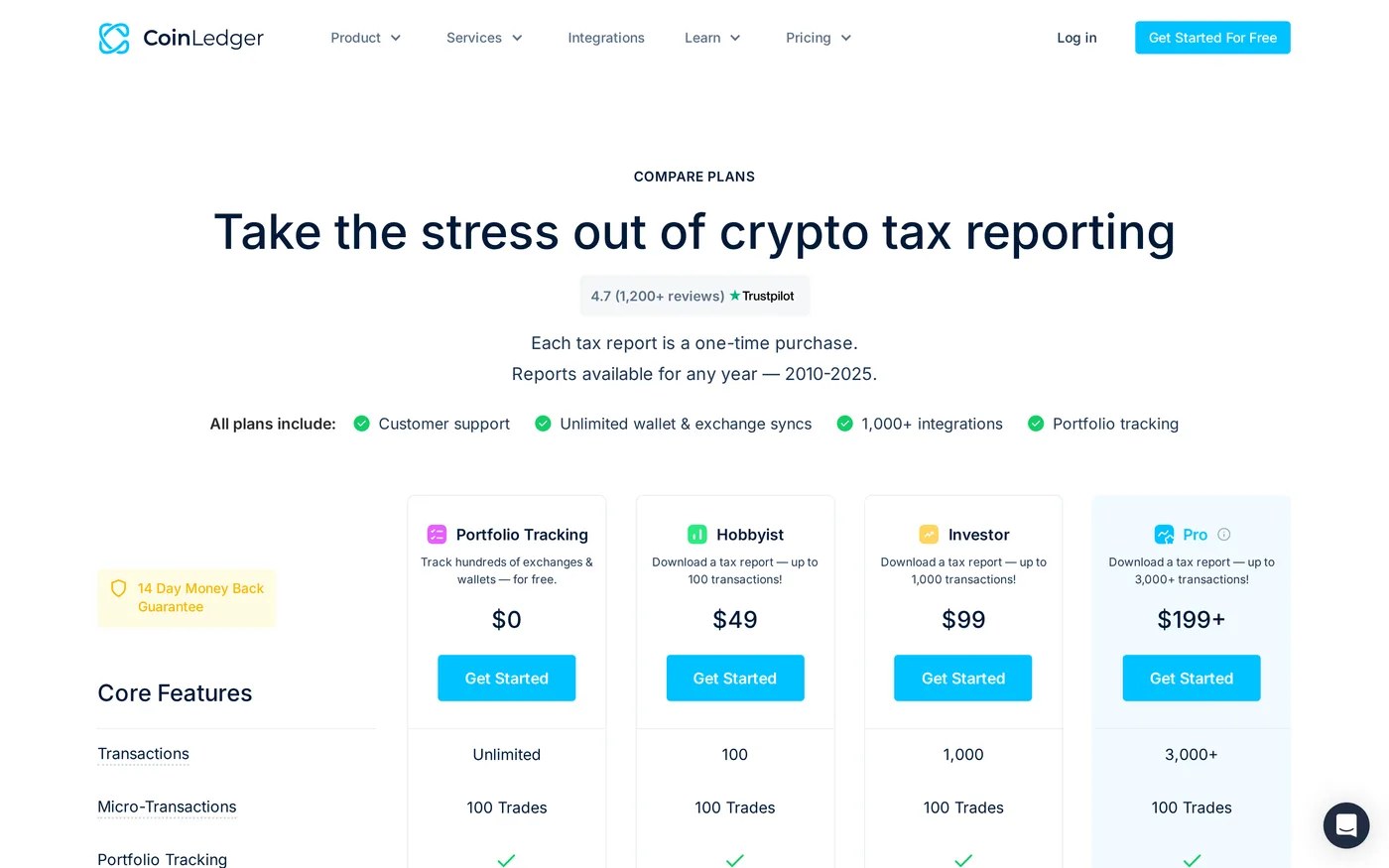
- Free to import; reports from ~$49 per tax year
What works
- Free import and preview — you see the numbers before paying anything
- Transaction tiers are more generous per dollar than CoinTracker's
- Clean export into TurboTax, TaxAct and accountant-ready formats
- Interface is simple enough to finish in one sitting
What does not
- International support is limited compared with Koinly
- DeFi and NFT classification needs manual work on anything unusual
- Portfolio tracking is a secondary feature rather than a real product
- No meaningful ongoing use outside tax season
A narrower product, deliberately
CoinLedger — previously CryptoTrader.Tax — has not tried to become a portfolio app, a market data provider or a year-round dashboard. It imports your transactions, classifies them, and produces a tax report. That focus shows in how quickly you can actually finish.
Like Koinly, import and preview are free. You pay to download, starting around $49 per tax year for a small transaction count and rising through tiers. Per transaction it generally works out cheaper than CoinTracker at equivalent volumes, which is the main reason to choose it.
What it handles well
Centralised exchange history via API or CSV, including several defunct exchanges through file import.
Standard capital gains reporting with the usual cost-basis method options.
Export into TurboTax, TaxAct and generic accountant formats without reformatting by hand.
Income classification for staking and mining rewards at the common level of complexity.
Where you will do manual work
NFT transactions, liquidity positions and anything involving a protocol that mints a receipt token require review. The tool will make a guess; the guess is right often enough to be useful and wrong often enough that you cannot skip the check.
This is not a failing unique to CoinLedger. On-chain activity does not carry tax semantics, and no importer can reliably infer intent from a contract call — the chain records what happened, not what you meant by it.
The reconciliation checklist
Import everything first, including wallets you are confident are empty.
Resolve every transfer warning before looking at a single total.
Check every zero cost basis — each one is an unimported acquisition inflating your gain.
Confirm the cost-basis method matches what your jurisdiction actually requires.
Sanity-check the largest three disposals by hand against what you remember doing.
Doing this properly takes longer than the software's marketing implies, and it is the entire value of the exercise. A report you have not reconciled is a guess with a logo on it.
Income versus capital gains
Staking rewards, mining income, airdrops and referral payments are generally income at the moment you receive them, valued at the price then, and they also establish a cost basis for a later disposal. Get the first part wrong and you understate income; get the second wrong and you overstate the gain when you sell.
CoinLedger handles the common cases correctly and will ask you to classify the unusual ones. An airdrop of a token with no market at the time of receipt is the classic hard case, and no software can resolve it for you — that is a question for your accountant, and it is worth asking before the software guesses.
The international gap
Support outside the US exists but is shallow. If you file in the UK with share pooling rules, or in Australia, or in more than one country, Koinly handles it properly and this does not.

Verdict
The free portfolio side
CoinLedger offers free portfolio tracking alongside the tax product, which is a reasonable way to keep the data current rather than assembling it once a year under time pressure. It is thinner than a dedicated tracker and it is free, and the main benefit is that your transaction history stays imported.
The practical value of that is not the dashboard. It is that an exchange which shuts down, or restricts API history to the last two years, cannot take data from you that you already pulled.
Choosing between this and Koinly
Both are free until download, both have similar entry pricing, and both produce reports a professional will accept. The decision comes down to where you file.
US only, exchange-heavy history: CoinLedger, on price and simplicity.
US only, heavy DeFi and NFT activity: either, and budget for manual classification whichever you pick.
Anywhere else, or more than one country: Koinly, without hesitation.
Filing through an accountant who has a preference: whichever they name.
The audit trail
CoinLedger's reports include the underlying transaction detail rather than only summary figures, which matters if a return is ever questioned. A summary number you cannot substantiate is worse than no software at all, because it looks authoritative.
Keep the exported detail alongside the filed report, and keep the raw exchange exports too. Software companies change, discontinue products and lose data; your own archive does not.
Score: 7.5. Good value, appropriately scoped and honest about being a tax tool rather than a platform. For a US filer choosing on price, this beats CoinTracker. For anyone filing elsewhere, it is the wrong product at any price.