Verdict
Nothing else matches Binance on depth or on the cost of a large order. The price of that is concentrating your counterparty risk in one offshore group that has already been fined billions and still will not tell you plainly which entity holds your coins.
- Best for
- High-volume spot and futures traders
- Cost
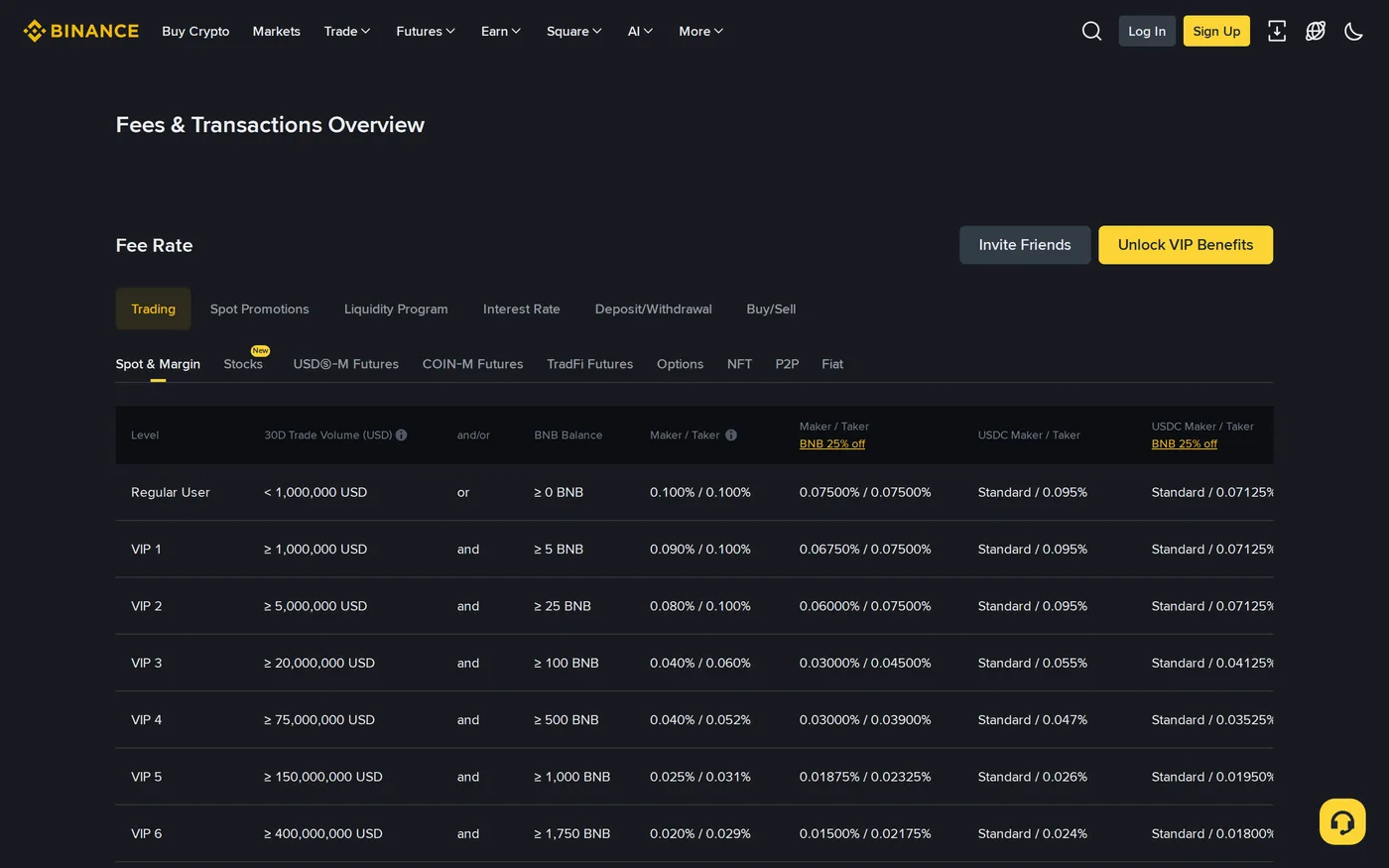
- 0.10% spot maker/taker, 0.075% with BNB
What works
- Deepest order books in the industry across hundreds of pairs
- 0.075% effective spot fee once BNB fee payment is switched on
- Monthly Merkle-tree proof of reserves covering the major assets
- Futures, margin, earn and conversion all settle from one balance
What does not
- Entity you contract with depends on your country and is not obvious at signup
- Withdrawal suspensions during network incidents are announced late
- The $4.3bn US settlement and its monitorship still shape what you can access
- Interface buries the plain spot order form under six other products
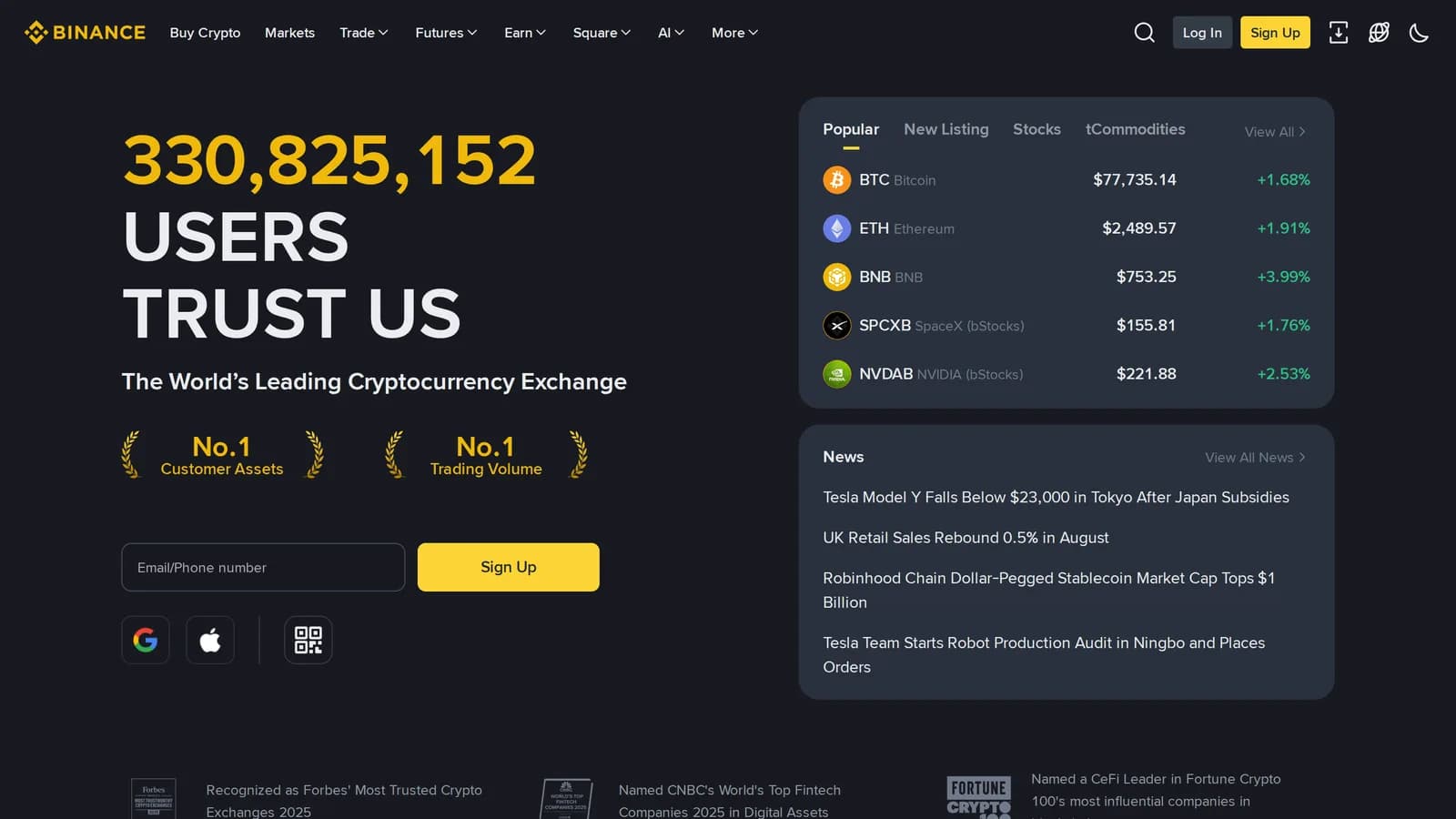
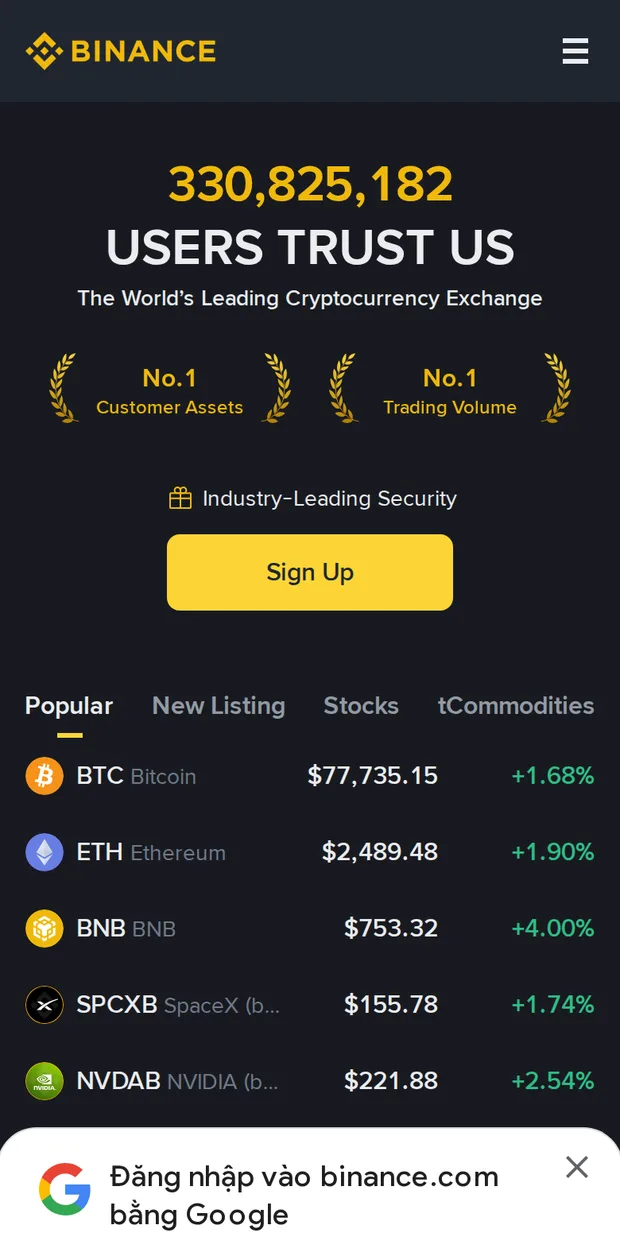
Start with the number Binance puts on its own front page: more than 330 million registered users, and a 24-hour trading volume quoted in the tens of billions of dollars. Whatever you think of the company, that scale is real, and it is the entire reason to use the exchange. On a $50,000 market buy of BTC/USDT you will pay less in slippage here than anywhere else, and the gap is not marginal.
The question this review is actually about is what you give up for that. Because you do give something up, and it is not the fee.
The fee schedule, and the version of it you will actually pay
Spot trading starts at 0.10% maker and 0.10% taker for a regular VIP 0 account. Switch on the option to pay fees in BNB and that drops 25%, to 0.075%. Both sides. There is no tier on any other large centralised exchange that beats an unfunded new account here, which is unusual — most venues charge beginners the most and reserve the good pricing for people who no longer notice it.
The VIP ladder then runs on a combination of 30-day trading volume and BNB balance, and the maker side falls faster than the taker side. USDⓈ-M perpetual futures start at 0.02% maker and 0.05% taker, which is the pricing the rest of the market benchmarks against. Coin-margined contracts are priced separately and slightly differently, and the fee page distinguishes them properly.
Where the schedule stops being honest is the Convert button. Converting is quoted as zero fee, and it is — the cost is in the spread you are quoted instead, and on thinner pairs that spread is worth several times the 0.075% you were trying to avoid. The feature exists because a zero next to the word 'fee' converts better than a number. If you can read an order book, never use Convert.
Withdrawal fees are set per asset and per network, and they are one of the few places where Binance is straightforwardly good: the network selector shows the cost before you commit, and moving a stablecoin over a cheap network costs a fraction of what several competitors charge for the same transfer.
Who is holding your coins
This is the part that should determine whether you use Binance, and the part the site is least direct about. Depending on where you are, your account may sit with the main offshore holding company, a MiCA-registered European entity, a Dubai VARA-licensed entity, or a local partner operating under its own name. Those entities have different regulators, different insolvency treatment and different withdrawal terms, and the signup flow does not present that choice as a choice — it infers it from where you appear to be.
Binance publishes a monthly proof of reserves using a Merkle tree, with a zk-SNARK-based verification path so users can check that their own balance is included in the total without exposing everyone else's. That is meaningfully better than a screenshot of a wallet balance, and better than most of its competitors manage. It is still an asset-side statement at a point in time. It does not tell you what the liabilities look like, and it does not resolve the entity question above.
A reserve attestation answers 'do the coins exist'. It does not answer 'who has a claim on them if this goes wrong', and on Binance that second question is the harder one.
There is also the SAFU fund, an insurance pool the exchange maintains against catastrophic losses. It is real, it has been used, and it is discretionary. It is a company policy, not a deposit guarantee, and the distinction matters most in exactly the scenario where you would be relying on it.
The listing firehose
Binance lists aggressively — new tokens, Launchpool farms, seasonal campaigns — and the effect on a retail account is that the interface is permanently trying to sell you something. Earn, Square, Copy Trading, the AI tab, the bot marketplace, a rotating banner of promotions. The plain spot order form is three taps deep on mobile.
If you came here to buy BTC once a month, this is the wrong venue. You will pay less than anywhere else and spend the whole time declining offers. The cognitive cost is real, and for an inexperienced user the nudge towards leverage products is the single most expensive feature on the platform.
Support, and what happens when it goes wrong
Support is chat-first and template-heavy. Routine problems — a stuck deposit on the wrong network, a KYC re-verification, a withdrawal held for review — get resolved, slowly. Anything unusual escalates into a loop of copy-paste replies from agents who cannot see the system that made the decision.
Withdrawal suspensions during chain congestion or an incident are usually posted to the status page after users have already noticed them on social media. For a venue of this size, that communication lag is a choice rather than a capacity problem.
The 2023 US settlement — $4.3 billion, a guilty plea from the founder, and an ongoing compliance monitorship — is not ancient history in practice. It is why the product surface differs so much by jurisdiction, why features occasionally vanish from your account without warning, and why the terms you agreed to at signup may not be the terms that apply to you next year.
How it compares
Against OKX: OKX undercuts Binance on entry-tier maker fees and has a better-organised interface. Binance wins on depth, especially outside the top twenty pairs.
Against Kraken: Kraken costs more and answers the phone. If you are holding rather than trading, that trade is usually worth making.
Against Coinbase: Coinbase is more expensive and auditable. Binance is cheaper and opaque. Those are the two honest positions in this category.
Who it is for
Active traders who care about fill quality on size and are willing to hold balance on an offshore venue for as short a time as possible.
Futures traders benchmarking funding and liquidation mechanics against the deepest perpetual market available.
Anyone trading pairs that simply do not have a book anywhere else.
Practical advice if you use it
Enable BNB fee payment on the first day. It is one toggle and it cuts your trading cost by a quarter permanently.
Use the spot order form, not Convert, for anything you would notice losing.
Check the withdrawal network selector every time — the same asset can cost cents on one network and tens of dollars on another.
Withdraw to self-custody on a schedule rather than when you remember. Balances left on an exchange tend to stay there.
Screenshot your VIP tier and fee page when you sign up. Schedules change and the archive matters if you ever dispute a charge.
The security hygiene is the same as anywhere: a hardware security key rather than SMS, a withdrawal address allowlist with a time delay, and an API key set that is read-only unless you specifically need it to trade. Binance supports all three properly, and the address allowlist in particular has stopped a great many account compromises from becoming losses.
Everybody else is paying a risk premium they are not being shown, in exchange for a cost saving measured in basis points. Score: 8.4. The execution is the best in the category and the disclosure is not, and no amount of liquidity makes an unnamed counterparty a good place to keep long-term savings.