Verdict
Founded in 2011, licensed in Luxembourg, acquired by Robinhood in 2025. Bitstamp is boring in the way a utility is boring: a short asset list, unremarkable fees, and fourteen years without losing customer funds.
- Best for
- European users who want a licensed, long-lived venue
- Cost
- 0.30% at entry tier, falling with volume
What works
- Operating continuously since 2011 with no catastrophic loss of customer funds
- EU licensing through Luxembourg with MiCA alignment
- Deliberately short asset list — everything listed has been screened
- Straightforward fee schedule with no token-discount games
What does not
- Entry-tier 0.30% is expensive against every large competitor
- Asset list will frustrate anyone beyond the top thirty tokens
- Robinhood acquisition raises unresolved questions about product direction
- Interface is dated compared with newer venues
Every exchange in this library will tell you it is secure. Bitstamp is one of the few that can point at a fourteen-year record and let you check it. Founded in 2011, it has outlived Mt. Gox, the ICO cycle, the 2022 credit collapse and most of its contemporaries, without a loss event that cost customers their balances.
In 2025 it was acquired by Robinhood. That is the main new fact about this exchange, and the honest position is that it is too early to say what it means.
Cost
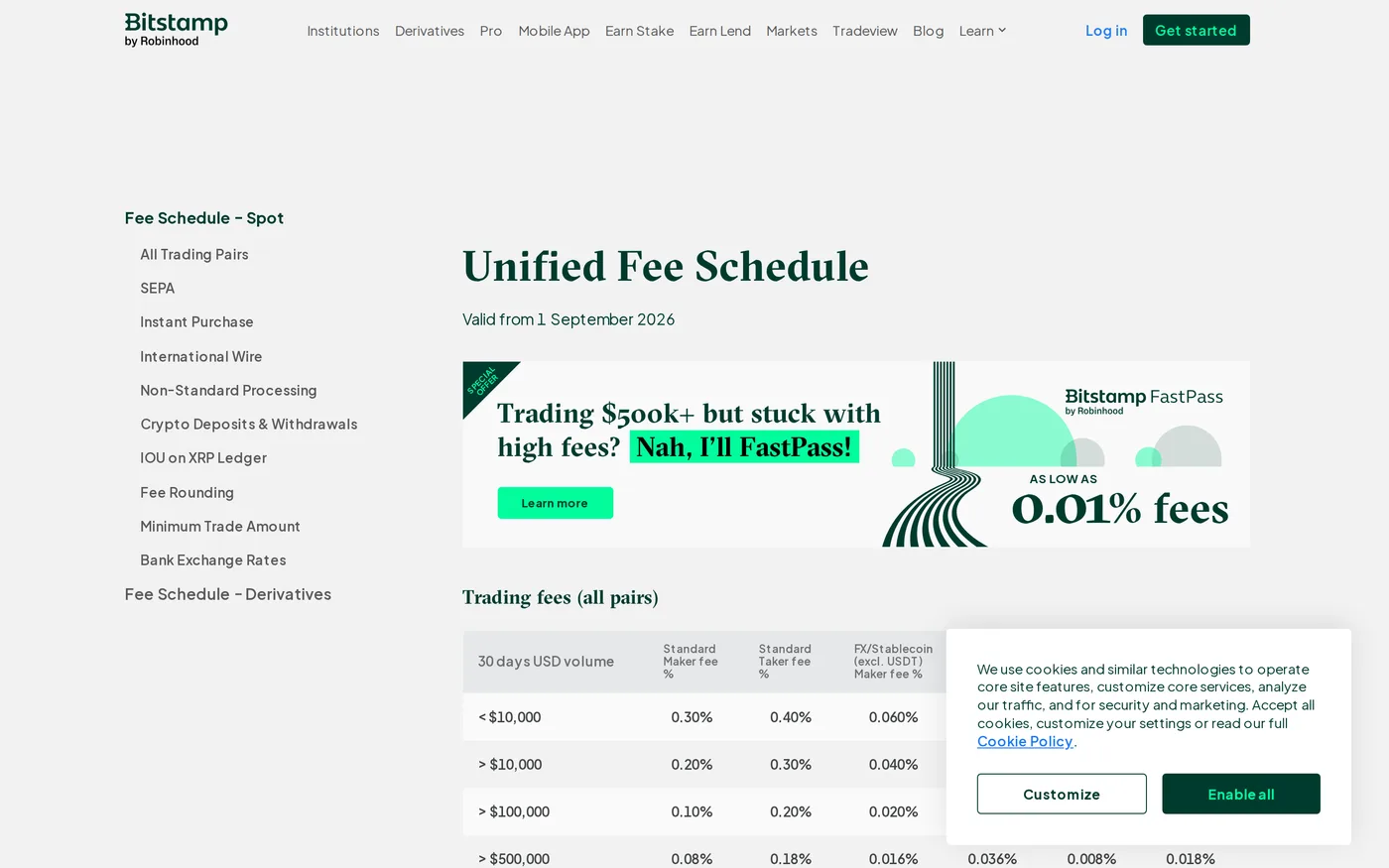
Fees start at 0.30% at the entry tier and fall on 30-day volume. Against Binance's 0.10%, OKX's 0.08% maker or MEXC's zero, that is expensive, and no amount of longevity makes 0.30% cheap for an active trader.
What you get for it is a venue that does not run a token discount scheme, does not gamify the interface, does not have a second cheaper exchange hidden behind the one you are using, and does not change the answer depending on which country it thinks you are in.
The short list is a feature
Bitstamp lists a fraction of what MEXC or KuCoin carry. Every asset on it has been through a listing process, and the delisting behaviour is conservative rather than reactive.
For a reader whose plan is to hold BTC and ETH and perhaps three other things, a short list is not a limitation. It is a filter someone else already applied, staffed by people with a licence to lose if they apply it badly.
Licensing
The Luxembourg base gives EU customers a named regulator with a complaints process, and the entity structure is presented clearly rather than buried in a terms document. That transparency is worth more than it sounds: on several venues in this library, working out which company you actually have a contract with takes real effort and a careful reading of the small print.
The Robinhood question
Robinhood's own crypto product is a retail brokerage with a different philosophy — order-flow economics, a simplified interface, a much larger and less experienced user base. Whether Bitstamp keeps its institutional and European character under that ownership is genuinely unresolved.
Nothing has visibly degraded so far. The fee schedule, the asset list and the licensing are intact.
The branding has begun to merge, which usually precedes product merging.
If you chose Bitstamp specifically for its conservatism, watch the terms-of-service updates over the next year rather than assuming continuity.
How it compares
Against Kraken: similar philosophy, Kraken is cheaper and has better support. Against Coinbase: similar regulatory posture, Coinbase has far more depth and a US focus. Against Bitpanda: both target European retail, Bitstamp is an order-book exchange and Bitpanda is primarily a broker.
The comparison that actually decides it is against yourself in five years. A venue that has never had to make its customers whole after an incident is worth a premium that no fee table will ever show, and 20 basis points on a monthly purchase is a small price for a counterparty that has declined every profitable shortcut for fourteen years.
Verdict
What fourteen years actually bought
Bitstamp's record is not accidental. The venue has consistently declined the things that killed its contemporaries: it did not run a lending desk against customer deposits, it did not issue a platform token, it did not list assets to capture a listing fee, and it did not offer leverage to retail at scale.
Every one of those decisions cost revenue in the good years. All of them are why the exchange is still here, and it is the clearest demonstration in this library that the risky feature and the profitable feature are usually the same feature.
Custody and institutional posture
Customer assets are held with a documented custody arrangement and institutional clients have access to segregated arrangements. The disclosure is not as detailed as a US trust company's, and it is considerably better than any offshore venue's.
Account security supports hardware keys and withdrawal allowlisting. The interface for configuring both is dated, functional and has not changed much in years — which, for security settings, is a compliment.
Score: 7.8. Expensive, narrow, dated — and the venue with the cleanest operating recordin this entire library. For a European buyer who wants a licensed counterparty and does not trade often enough for 20 basis points to matter, that is a trade worth making.