Verdict
The closest thing to a straight competitor Binance has: comparable depth on majors, better spot pricing at the entry tier, and a far more coherent app. The regulatory record and the entity structure carry the same warnings.
- Best for
- Traders who want deep books with a usable interface
- Cost
- 0.080%/0.100% spot maker/taker, Lv1
What works
- Entry-tier spot pricing undercuts Binance's flat 0.10%
- Proof of reserves published monthly with zk-STARK verification
- On-chain wallet and DEX aggregator are integrated without being forced on you
- Trading interface is the best-organised of the large offshore venues
What does not
- $505m US settlement in 2025 over unlicensed money transmitting
- Which entity serves you depends on jurisdiction and changes without notice
- Earn and Jumpstart products push risk that the interface presents as yield
- Customer support is chat-only and slow on non-standard cases
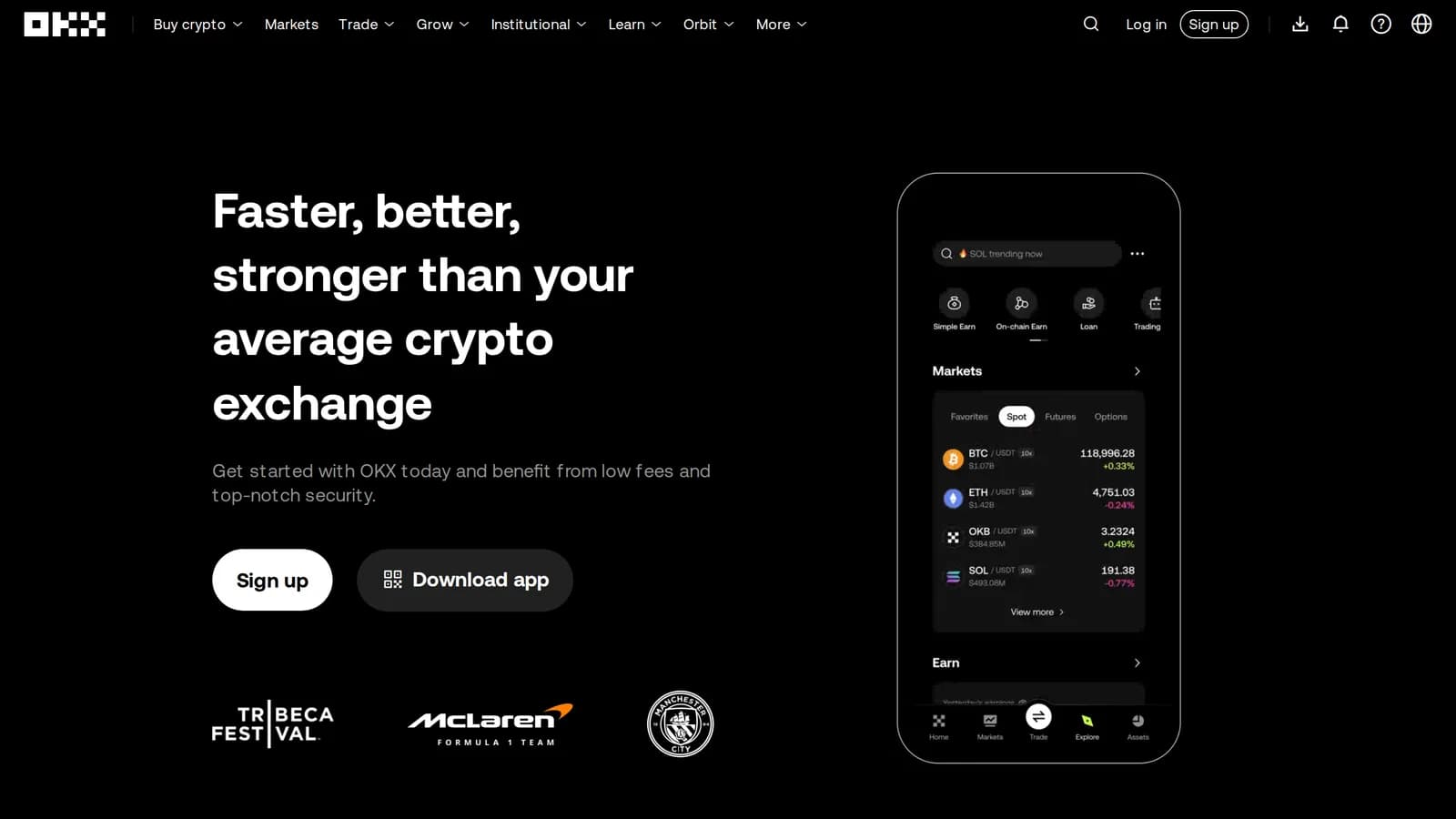
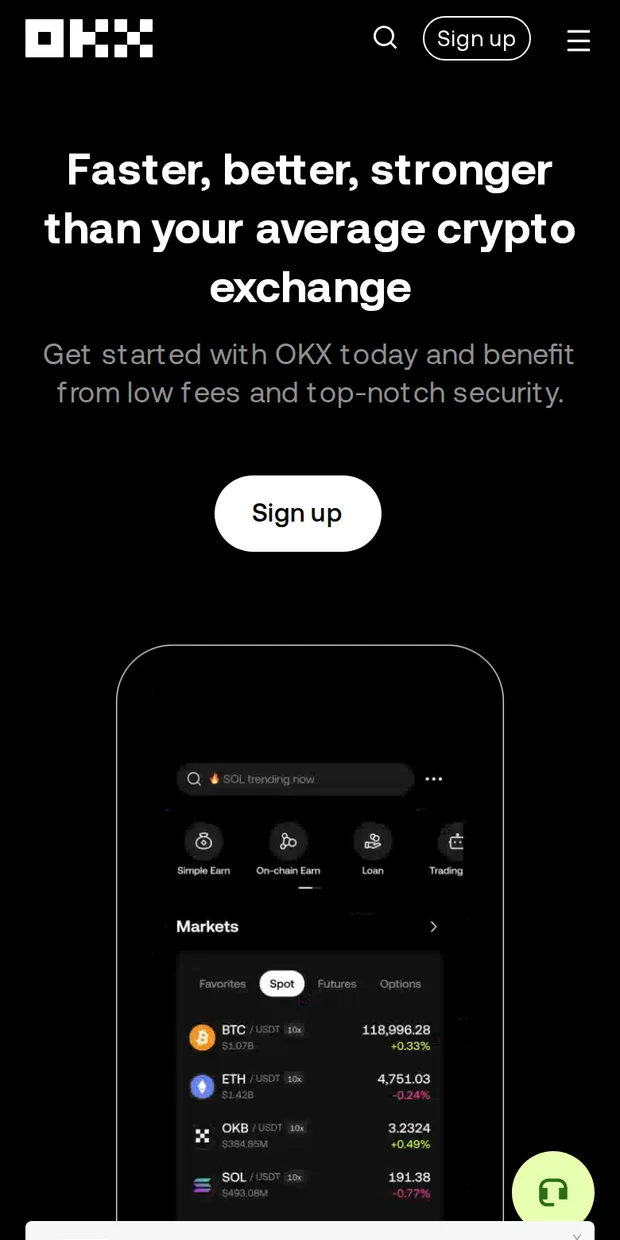
Put OKX and Binance side by side on a majors pair and the books look similar. Put the two apps side by side and they do not. OKX is the better-designed product by a distance — the trading view is not fighting five other tabs for attention, funding and position information sits where you expect it, and the on-chain wallet is available without being pushed into the middle of every flow.
Pricing
Spot starts at 0.080% maker and 0.100% taker for a Lv1 regular user, which quietly undercuts Binance's flat 0.10% on the maker side before any token discount is applied. Futures start around 0.020% maker and 0.050% taker. The VIP ladder runs on 30-day volume and asset balance in the usual way, with a separate tier track for market makers.
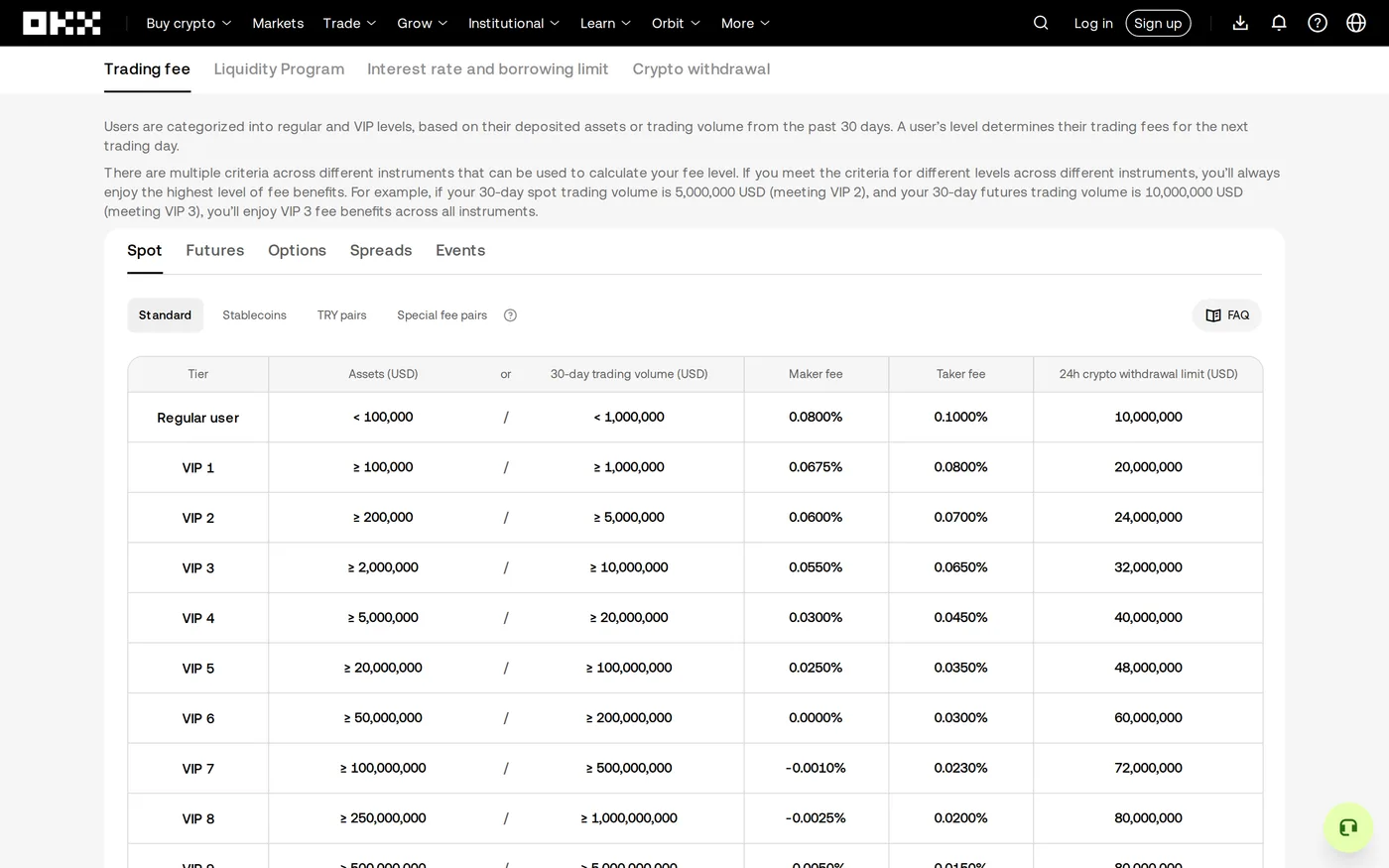
For a trader who posts liquidity rather than taking it, that entry-tier maker rate is the single best number in the large-venue category. It is also the reason OKX has been able to hold serious volume against a much larger competitor without resorting to permanent promotional pricing.
Reserves
OKX publishes a monthly proof of reserves using a Merkle tree with a zk-STARK verification path, covering the major assets and allowing an individual to verify their own balance is included in the total. The published reserve ratio for BTC, ETH and USDT has consistently been above 100%.
Same caveat as everywhere in this category: this is an asset-side statement at a point in time, produced by the exchange, verifying inclusion rather than solvency. It is a good version of a limited thing, and the limitation is inherent to the format rather than to OKX's implementation.
The legal record
In February 2025 the OKX operating entity pleaded guilty to operating an unlicensed money transmitting business in the US and agreed to penalties totalling roughly $505 million. The company has since pushed hard on licensing — a MiCA authorisation through Malta, a separate US entity, registrations across several other jurisdictions.
Read that as a pattern rather than a scandal: the large offshore venues grew first and licensed afterwards, and the bill arrives years later. The practical consequence for you is that product availability in your country is a moving target, and the entity you contract with may be replaced while your funds are sitting there.
Wallet and DEX
The OKX Wallet is a self-custody product with a DEX aggregator attached, and it is integrated into the app without being conflated with the exchange balance. That is the right design decision: the two balances are visibly different things with different risk, and several competitors deliberately blur exactly this line.
The aggregator routes across a long list of chains and is competitive with standalone aggregators on common pairs, though it is not the cheapest route on every swap. Treat it as convenient rather than optimal, and check the quote against a dedicated aggregator for anything large.
What we would avoid
Jumpstart and similar launch products, which sell early access to tokens that mostly trade below their launch price within a quarter.
Earn products quoting headline APRs without the counterparty structure attached — the yield is somebody's borrowing cost, and you should know whose.
Leaving long-term holdings on the exchange at all, given the entity questions above.
How it compares
Against Binance: cheaper for makers, better designed, shallower on the long tail of pairs. Against Kraken: significantly cheaper and significantly less accountable. Against Bybit or Bitget: broadly similar in structure, ahead on interface quality and reserve disclosure.
Verdict
Derivatives
The perpetuals product is the second-deepest among centralised venues and the risk engine is well documented — mark price construction, funding calculation and the tiered maintenance margin table are all published rather than summarised. For a trader sizing a position, that table is the most important page on the site and OKX is one of the few venues that makes it easy to find.
Unified account mode lets spot, margin and derivatives share collateral, which is capital-efficient and carries the same cascade risk as any cross-margin system: a liquidation in one book can consume collateral supporting another. It is off by default, which is the correct default.
Security and account hygiene
Hardware security keys, an anti-phishing code that appears in every legitimate email, and a withdrawal address allowlist are all supported. The anti-phishing code is a small feature that defeats a large fraction of real attacks, and OKX implements it properly.
API keys can be scoped to read-only or trade-only and bound to an IP address. If you run a bot, bind the key — an unbound trading key that leaks is the most common way an otherwise careful account gets drained through market orders rather than withdrawals.
Score: 8.0. If you are going to use an offshore venue with deep books, OKX is the better-built one. It undercuts Binance at the entry tier, publishes comparable reserve evidence, and has an app that respects your attention. It carries the same structural risk and the same regulatory history, which is why it does not outrank Kraken despite being cheaper.