Verdict
A New York trust company with real regulatory standing and a clean exchange product, permanently shadowed by the Earn programme that froze 340,000 customers out of roughly $900m in assets. The settlement returned the money. The lesson should not be discarded.
- Best for
- US users who want a regulated trust custodian
- Cost
- 0.20%/0.40% on ActiveTrader, ~1.49% in-app
What works
- NYDFS trust charter means a real regulator with examination powers
- ActiveTrader fees are competitive against US peers
- SOC 2 reporting and institutional custody with insurance on hot storage
- Earn creditors were ultimately made whole in kind
What does not
- The in-app buy flow charges roughly 1.49% plus spread
- Gemini Earn failure froze customer assets for over a year
- Asset list is narrow even by US standards
- Fee structure differs confusingly between the app and ActiveTrader
Gemini's founders built the exchange around a specific bet: that being the most regulated venue in the US would eventually be the winning position. They obtained a New York trust charter, submitted to NYDFS examination, published SOC 2 reports and insured hot storage. On the exchange product, that bet largely paid off.
Then they attached a lending programme to it, and 340,000 customers found out what counterparty risk means.
Earn, in full
Gemini Earn offered yield on customer assets. Those assets were lent to Genesis Global Capital. When Genesis froze withdrawals in November 2022, roughly $900 million of Earn customer funds froze with it. Customers who believed they were dealing with a regulated New York trust company discovered they were unsecured creditors of a bankrupt lender.
The eventual outcome was better than most: a February 2024 settlement with NYDFS, and Earn users ultimately received their assets back in kind, which given the price appreciation across that period made them whole and more. That is a genuinely good resolution and it should be stated as clearly as the failure.
The trust charter covered the exchange. It did not cover the yield product sold inside the same app, under the same brand, to the same customers. Almost nobody understood that distinction until it mattered.
The exchange itself
ActiveTrader starts around 0.20% maker and 0.40% taker at the entry tier and falls with volume. That is competitive with Coinbase Advanced and better than Kraken's entry tier on the maker side.
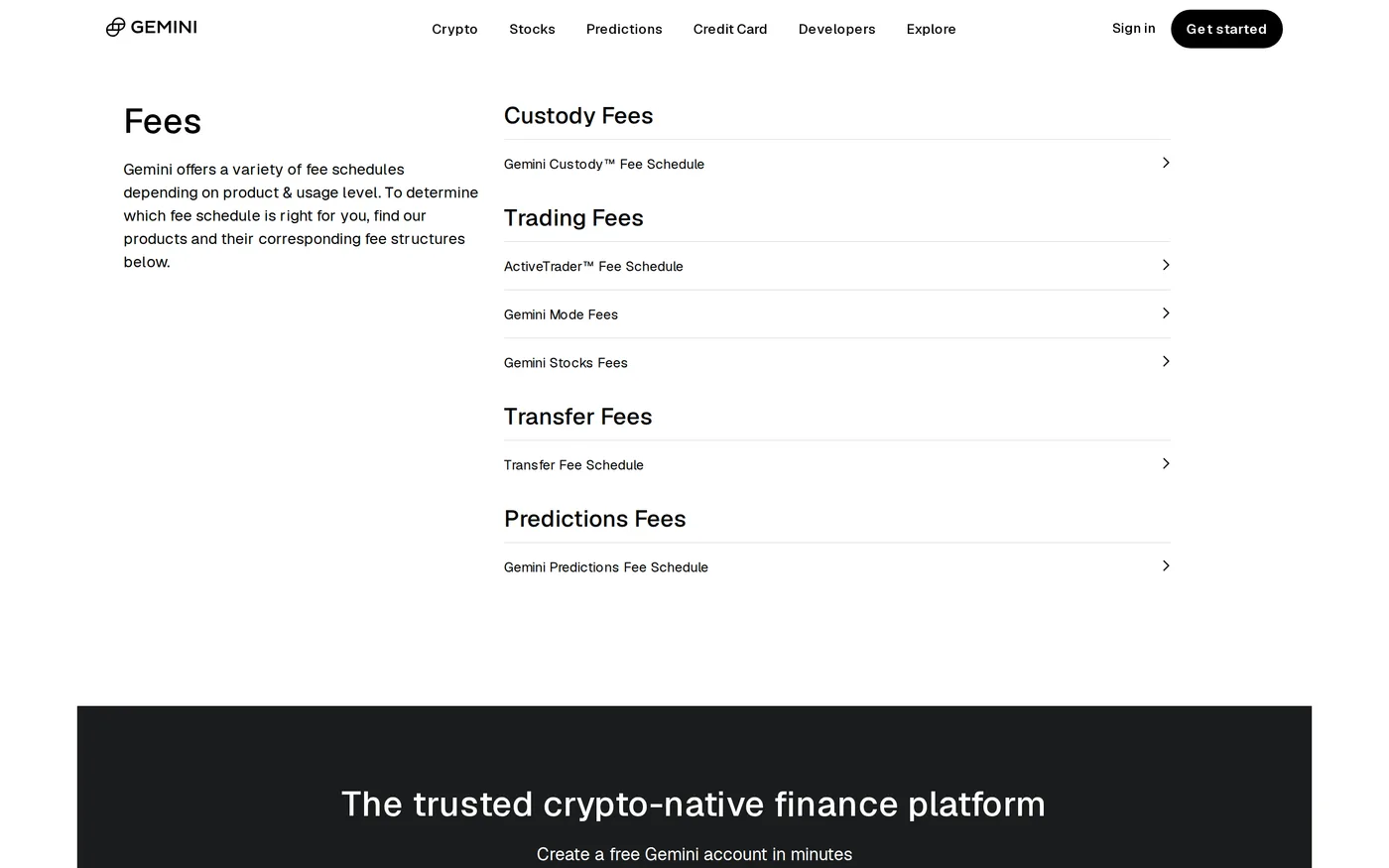
The consumer app is a different story: roughly 1.49% plus spread on a simple purchase. Same pattern as Coinbase, same advice — the cheap product is one tab away and the app will not mention it. Unusually, Gemini does publish both schedules on the same page, which makes the gap unusually easy to verify.
Custody
This is Gemini's strongest area. The trust structure means customer assets are held in a fiduciary capacity rather than as a general balance-sheet item, hot wallets carry insurance, and the operation is examined by a regulator with subpoena power.
For a US reader who wants exchange custody rather than self-custody, it is one of the two or three defensible choices, and the legal structure behind it is better than Coinbase's for that specific purpose.
What it is missing
Breadth. The asset list is short even against Coinbase, and new listings are slow.
Depth. Books are thinner than the volume leaders; large orders will move the price against you.
Consistency. The gap between app pricing and ActiveTrader pricing is not explained anywhere a new user will encounter it.
International reach. The product outside the US is much thinner than inside it.
Verdict
GUSD and the stablecoin question
Gemini issues GUSD, a dollar stablecoin under the same New York trust framework as the exchange. The regulatory structure behind it is genuinely stronger than most stablecoins can claim — reserves held in a regulated trust, examined by a state regulator with the power to act.
The practical problem is liquidity. GUSD is thin against USDT and USDC almost everywhere, which means the better-regulated instrument is the harder one to exit at scale. That trade-off is worth understanding before you decide the regulatory wrapper makes it the safer holding.
What the Earn episode should teach you
A regulated entity can sell an unregulated product inside the same app, under the same brand.
The phrase 'trust company' describes the custody of the exchange balance, not every product the company offers.
Yield on a custodial platform is a loan to somebody. Find out who before you accept the rate.
The eventual in-kind recovery was a good outcome that took more than a year, during which those assets could not be sold, moved or used.
That last point is the one people forget. Being made whole eventually is not the same as having access, and the period without access was the period when it would have mattered most.
Score: 7.4. The exchange and custody product are strong and the regulatory posture is real. The score is held down by the app's pricing and by Earn — not because the outcome was bad in the end, but because the episode showed how easily a regulated brand can carry an unregulated risk into a customer's account. Use the exchange. Do not use anything it labels as yield.