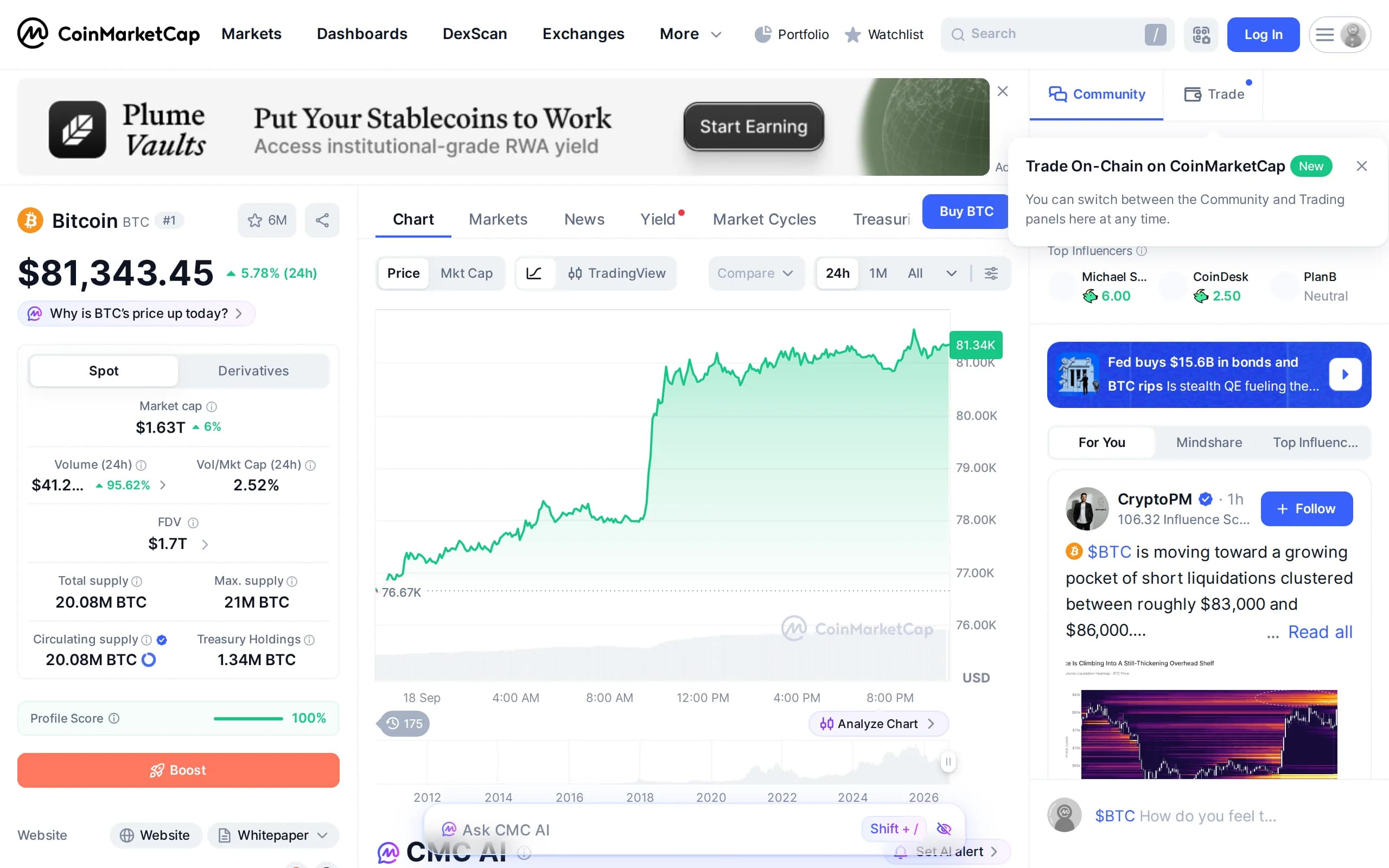
Bitcoin is trading at $81,345 at 02:28 UTC on 19 September 2026, up 5.8% in twenty-four hours and up 5.3% on the week. That is the largest single-day gain since the summer, and it arrives at the end of a week that contained a failed crypto bill in the US Senate and the Federal Reserve's first interest-rate increase in more than three years. Neither of those is good news for a risk asset.
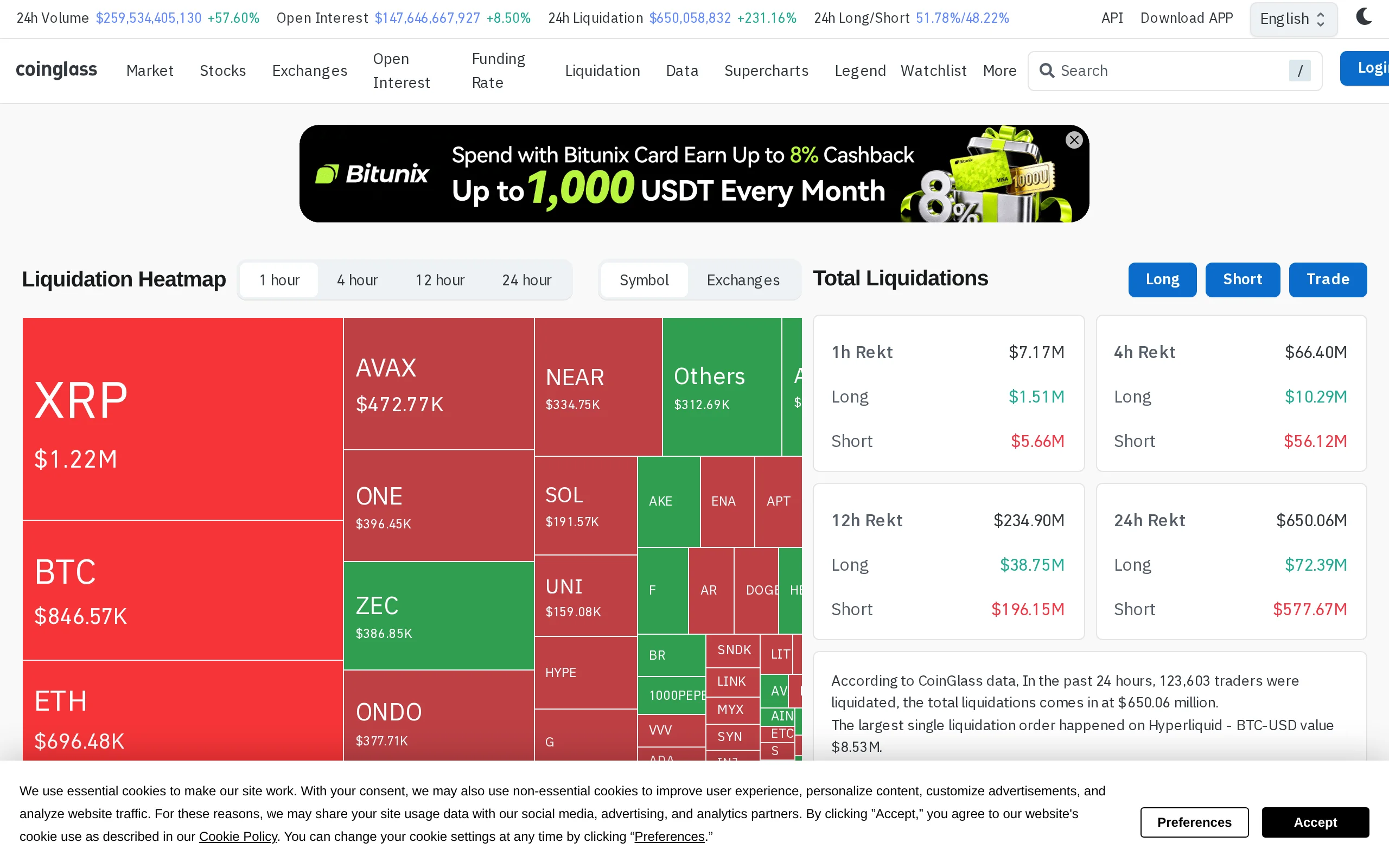
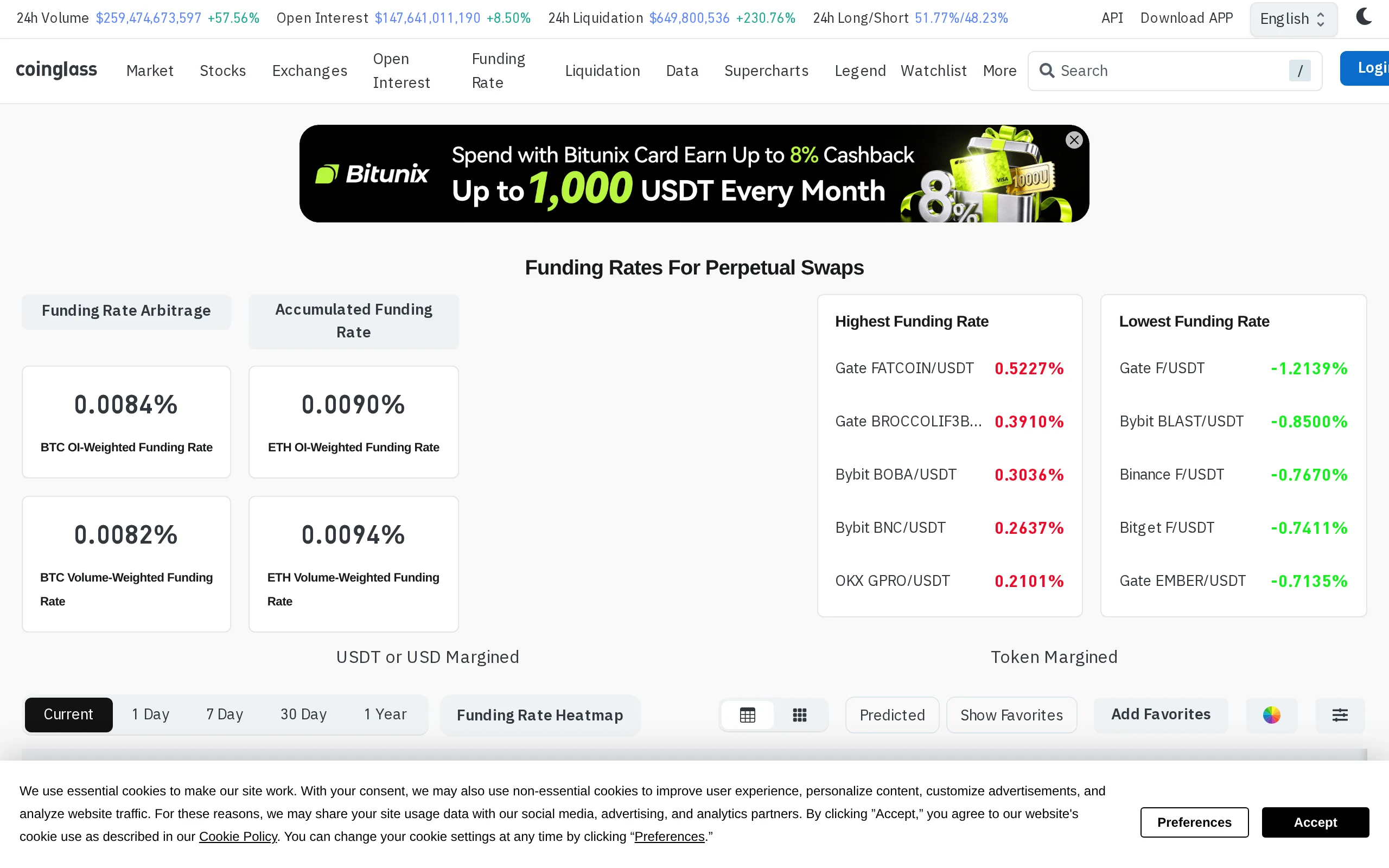
The explanation is in the derivatives data, not the headlines. Over the last twenty-four hours CoinGlass counts $650.06 million of crypto liquidations across 123,603 accounts. $577.67 million of that — 89% — was short positions. Longs accounted for $72.39 million. This was a crowd of traders positioned for a break below $75,000 being run over, not a wave of new buyers deciding bitcoin was cheap.
The shape of the move
The sequence matters. Bitcoin bottomed at $75,384 late on 15 September, hours after the Senate vote. It spent Wednesday and Thursday grinding back to roughly $76,500 — a slow, unremarkable recovery. Then on Friday, from about 10:00 UTC, it went from the mid-$76,000s to $80,900 in a few hours and has held there since, touching $81,606 overnight.
A step function like that is almost never spot demand. Spot buying takes time and leaves a sloped chart. Derivatives volume was up 57.6% on the day at $259.5 billion, and open interest rose 8.5% to $147.6 billion even as hundreds of millions of dollars of positions were being force-closed — the signature of a liquidation cascade pulling fresh leverage in behind it.
What it was recovering from
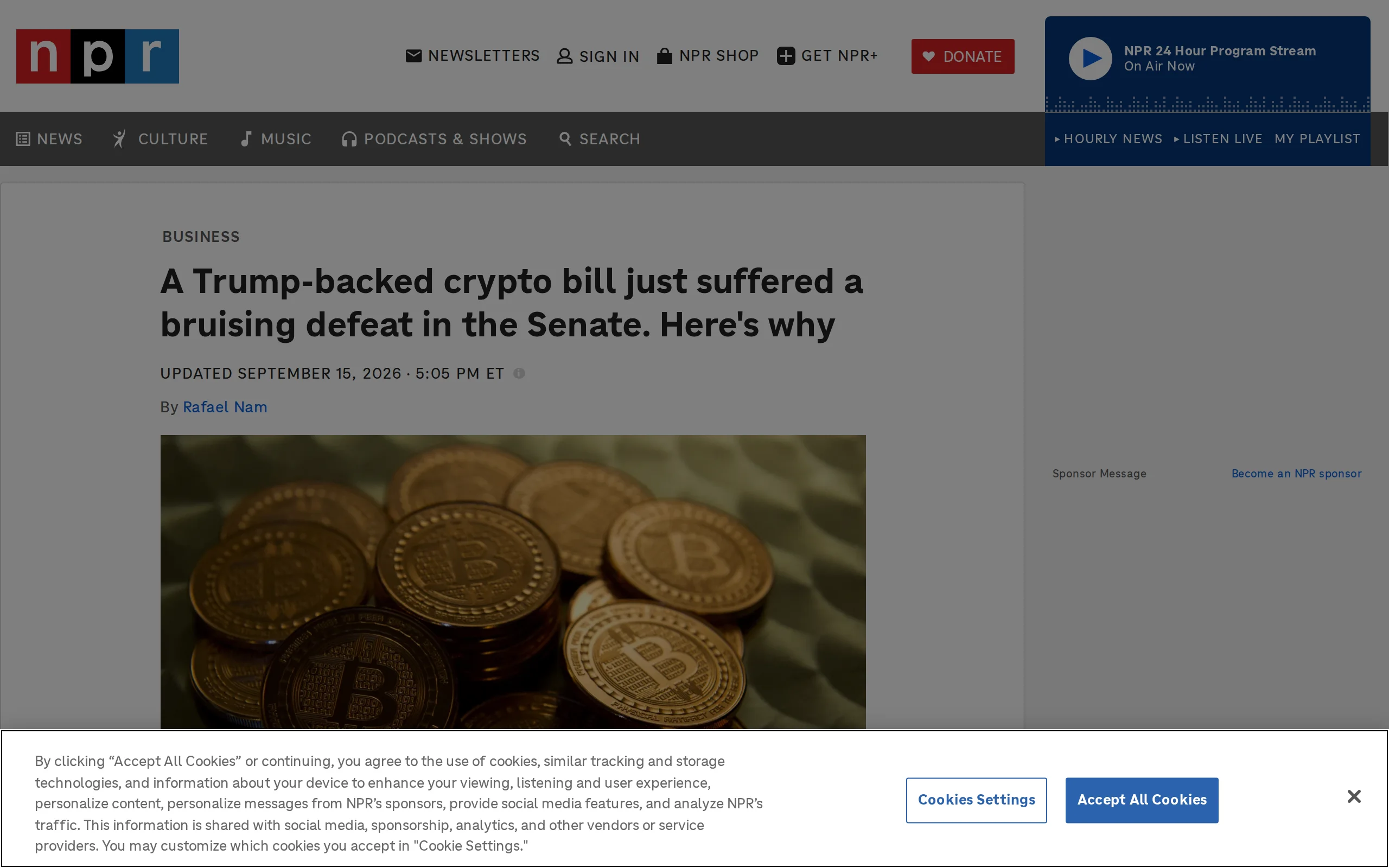
On Tuesday 15 September the Senate failed to invoke cloture on the Digital Asset Market CLARITY Act, H.R. 3633, by 49 votes to 50. Sixty were needed. The bill did not merely fall short of the threshold — it failed to win a simple majority. Every Democrat voted no, joined by four Republicans: Susan Collins, Josh Hawley, Jerry Moran and Thom Tillis.
The bill would have divided oversight of digital assets between the SEC and the CFTC and given the CFTC authority over spot markets, which is the single thing the American industry has been asking Congress for since 2018. Senator Cynthia Lummis, who led the negotiations, closed with "Let's vote yes. Let's not only join the 21st Century economy. Let's lead it." It was not enough. Bitcoin traded below $75,000 within hours.
Coinbase chief executive Brian Armstrong's reaction — "We let politics get in the way, I guess" — came with the industry's fallback position attached: that there is "another path, luckily, with the regulators, the SEC, and the CFTC." That path is real. The CFTC has already sent two rule packages, Regulation Crypto Asset Transactions and Regulation Crypto Asset Markets, to the White House budget office for review. But SEC chair Paul Atkins has said the plain thing about it, which is that agency rules will not be "durable without a law." Rules written by a regulator can be unwritten by the next one. That is the difference the vote destroyed, and Friday's rally did not restore it.
A rate rise that did not behave like one
Two days later the Federal Open Market Committee raised the federal funds target range by a quarter point to 3.75%–4.00%, on a 12–0 vote — the first increase since July 2023. Twelve of eighteen officials projected at least one more rise this year, with the median rate at 4.1% by December. The Bank of Japan moved the same week, to 1.25%. The dollar index went above 100 for the first time since July and the ten-year Treasury yield pushed toward 5%.
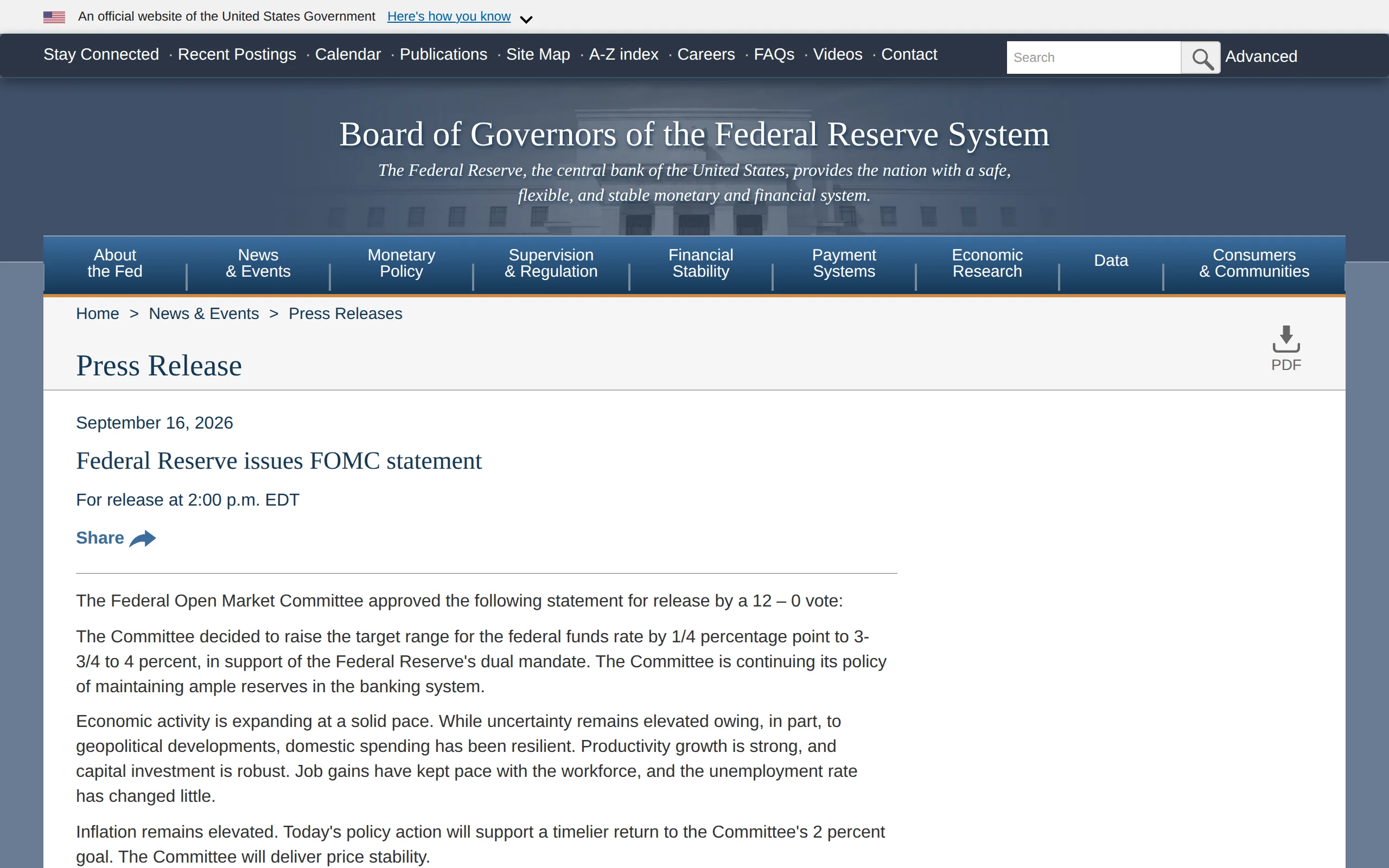
Crypto rallied into all of it. The honest reading is that the hike was fully priced — futures had it at near-certainty going in — and that the dot plot was softer than the decision. A median of 4.1% at year-end implies roughly one more move, not a campaign. Markets do not trade the news; they trade the distance between the news and what was already in the price, and on Wednesday that distance was slightly dovish.
The positioning says treat this carefully
Three numbers argue against reading Friday as a trend change.
Funding is flat. The open-interest-weighted perpetual funding rate for BTC sits at 0.0084%, with the volume-weighted rate at 0.0082% — effectively the 0.01% baseline. A genuine leveraged-long stampede pushes that number several multiples higher. Nobody is paying up to be long yet.
The ETFs were selling into it. US spot bitcoin funds saw $746 million of net outflows on Tuesday and Wednesday combined, after a $46.26 million outflow the previous week. The institutional bid did not cause this.
The starting point was a short crowd, and it is gone. Long/short account ratios sit at 51.78% to 48.22%, close to even. The fuel that produced a 5.8% day has been burned.
The altcoin tape was broader than bitcoin's, which is usually a late-stage tell rather than an early one. Solana added 12.7% to $113.30, a seven-month high. Ether rose 7.3% to near $2,600. XRP gained 8.9%. Hyperliquid's HYPE hit an all-time high around $92. Equities followed: Strategy up double digits, Coinbase up around 10%, Gemini's listed stock up 31%. FxPro's Alex Kuptsikevich described traders as "cautiously shifting their focus towards altcoins" while noting that weekend profit-taking could postpone a test of $82,000.
The comparison nobody wants
There is a precedent for a bitcoin rally that begins with the Fed's first hike of a cycle. In March 2022 bitcoin was also about 40% below its record when tightening started. It rallied 18% over the following twelve days. Then it fell roughly 50% over the following months.
A short squeeze is a fact about other people's positions. It tells you what was crowded; it does not tell you what anything is worth.
The similarity is not a forecast — the 2022 slide had FTX in the middle of it, and there is no equivalent solvency event visible today. But the structural setup rhymes closely enough that the burden of proof sits with the bulls. Bitcoin is still 35% below its October 2025 high of $126,080 and 31% lower than a year ago, even after this week. Market capitalisation is $1.63 trillion.
What would make this real
ETF flows turning positive. Two consecutive weeks of net creations would mean the move outlived the liquidations.
Holding above $80,000 through a quiet session. Squeeze gains that survive a low-volume weekend are different from squeeze gains that do not.
A clean break of $82,281. That is the level most desks are marking as immediate resistance; above it the next short cluster sits in the $83,000–$86,000 band.
Something concrete from the CFTC. The rule packages at OMB are now the only regulatory progress available this year.
Against that, $75,569 is the level the market defended on Tuesday, and losing it would put this entire week back on the table.
Prices in this article were taken at 02:28 UTC on 19 September 2026 and will have moved by the time you read it. Nothing here is investment advice, and a crowded short book is not a reason to do anything in particular.