Verdict
No token, no paywall on the core product, methodology in a public repository, and the TVL figures the entire industry quotes. The best free tool in crypto and the clearest example of what structural neutrality is worth.
- Best for
- DeFi TVL, yields, stablecoins and protocol comparison
- Cost
- Free; optional Pro API around $300/month
What works
- Core product is entirely free with no account required
- Adapters are open source, so any figure can be traced to its calculation
- Covers TVL, yields, stablecoins, bridges, fees, unlocks and hacks in one place
- No token and no exchange ownership — nothing to talk its own book with
What does not
- TVL is an inherently flawed metric that double-counts across protocols
- Yield listings include pools whose returns are emissions rather than revenue
- Interface is dense and assumes familiarity with DeFi vocabulary
- Community-contributed adapters vary in maintenance quality
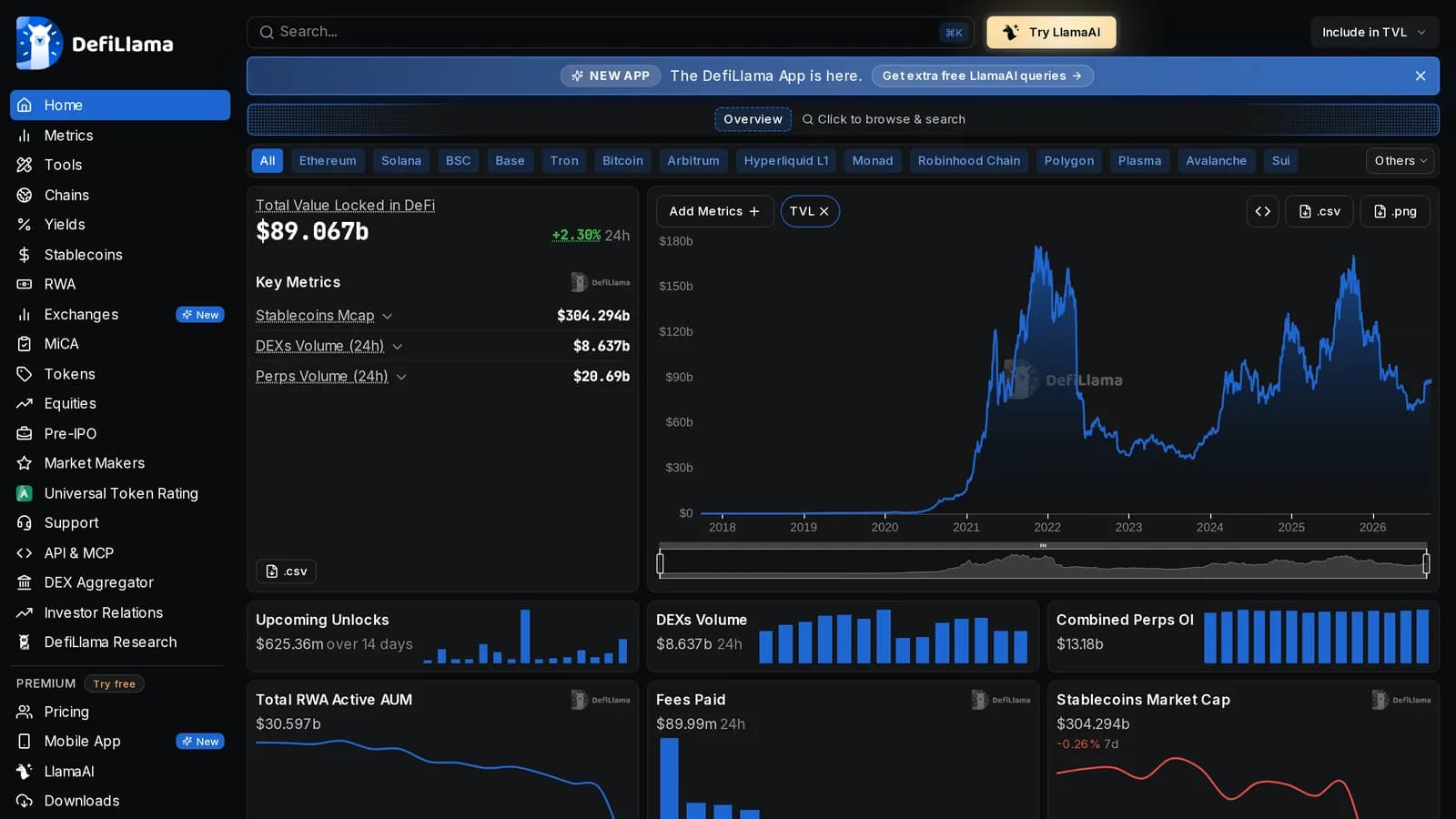
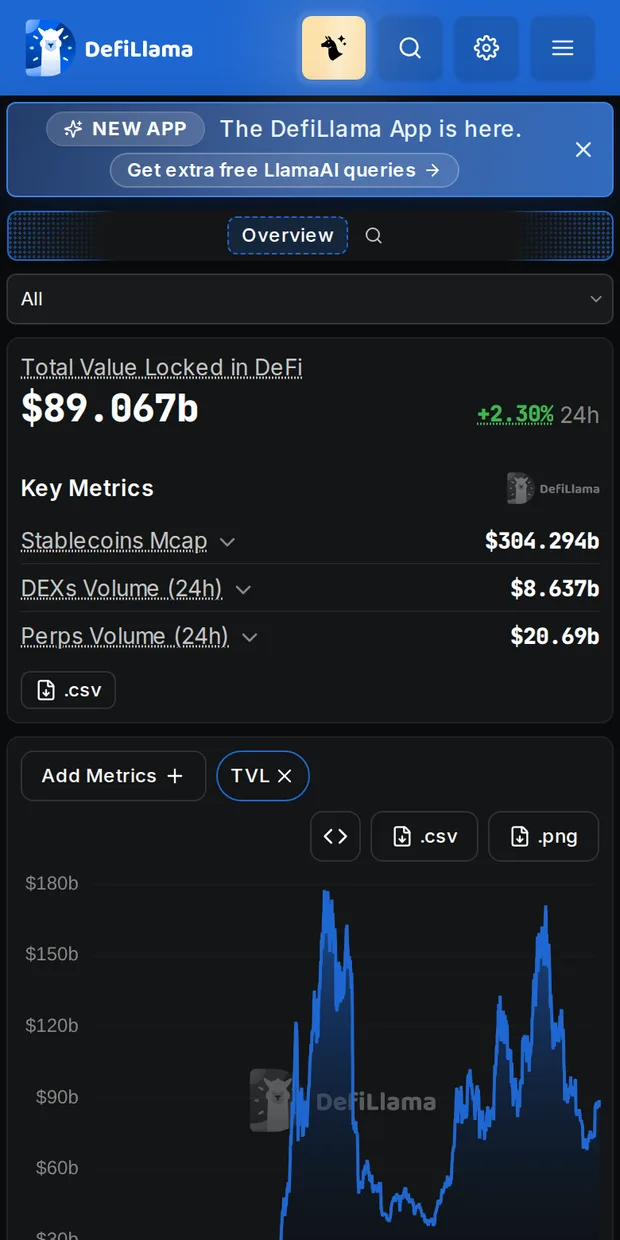
DefiLlama is the closest thing DeFi has to a public utility. It aggregates total value locked across thousands of protocols and hundreds of chains, tracks yields, stablecoin supply, bridge volumes, protocol revenue, token unlocks and a running catalogue of hacks. It charges nothing for any of it, has no token, and publishes the code that produces every number.
In an industry where most data providers are owned by exchanges or funded by the protocols they cover, that is not a small thing. It is arguably the most important thing in this entire category.
Why the open adapters matter
Every protocol's TVL is calculated by an adapter — a small piece of code in a public repository that reads the relevant contracts and returns a number. If a figure looks wrong, you can read the adapter and see exactly what is being counted and what is not.
Compare that with a closed data provider, where a number is an assertion and the methodology is a paragraph of marketing prose. Here, disputes are resolved by reading code and submitting a pull request, which is how disputes about public data ought to be resolved and almost never are.
TVL is a flawed metric, and that is not DefiLlama's fault
Everyone uses it. Everyone should understand its limits before quoting it.
Double counting. Deposit ETH in a liquid staking protocol, use the receipt token in a lending market, borrow against it and deposit that somewhere else: one underlying asset, several TVL entries. DefiLlama offers filtered views precisely because of this.
Price sensitivity. TVL denominated in dollars rises when the deposited assets appreciate, without a single new deposit arriving.
Mercenary capital. TVL attracted by an emissions programme leaves when the emissions stop, and it says nothing about whether the protocol is useful.
Read TVL as a rough measure of scale and never as a measure of quality or safety. The list of largest protocols by TVL includes several that have been exploited, and being large has not historically prevented that.
The yield dashboard
The yields section aggregates pools across chains with their APY, and — crucially — separates base yield from reward yield. Base is what the pool earns from actual activity. Reward is token emissions.
A 60% APY that is 2% base and 58% emissions is a completely different proposition from a 9% APY that is entirely base. That distinction is the single most useful thing on the site, and most competing yield aggregators either do not draw it or bury it behind a tooltip.
If the yield is emissions, you are being paid in a token whose price is a function of how many people are being paid in it. Model that before you deposit.
Everything else it tracks
Stablecoin supply by issuer and chain, which is the best available proxy for capital entering and leaving the ecosystem.
Bridge flows, useful for watching capital rotate between chains before the narrative catches up.
Protocol fees and revenue, with the same definitional care Token Terminal applies.
A hacks database that is more complete and better maintained than any commercial equivalent.
How it is funded
A Pro API tier, around $300 a month, serves commercial users who need programmatic access at volume. The web interface stays free and complete, with no degraded features and no account wall.
That is a sustainable model that does not compromise the free product, and it is precisely why DefiLlama has no reason to flatter anybody's numbers.
Verdict
The hacks database
DefiLlama maintains a running catalogue of protocol exploits with amounts, dates, chains and attack classifications. It is more complete than any commercial equivalent and it is free.
Read it before depositing into anything. Not because past incidents predict future ones, but because the classifications show you which failure modes actually recur — oracle manipulation, bridge compromise, access-control errors, compiler bugs — and how much of the category's total loss each one accounts for. That is a better education in DeFi risk than any audit report.
Using it well
Switch on the double-count filters before quoting a TVL figure to anybody.
In the yields section, sort by base APY rather than total, then look at what the emissions add.
Check a protocol's fee revenue alongside its TVL — a large protocol earning nothing is a subsidy, not a business.
Use the chain comparison to see where activity is genuinely moving rather than where the marketing is loudest.
The interface rewards knowing what you are looking for. It is dense, unpolished and assumes fluency, which is the cost of a tool built by people who use it themselves rather than by a design team optimising for a first impression.
Score: 9.0 — the highest in this library. Free, open, structurally neutral, and the reference the rest of the industry defers to. The metric it is famous for has real conceptual problems, and DefiLlama documents them more clearly than its critics do.