Verdict
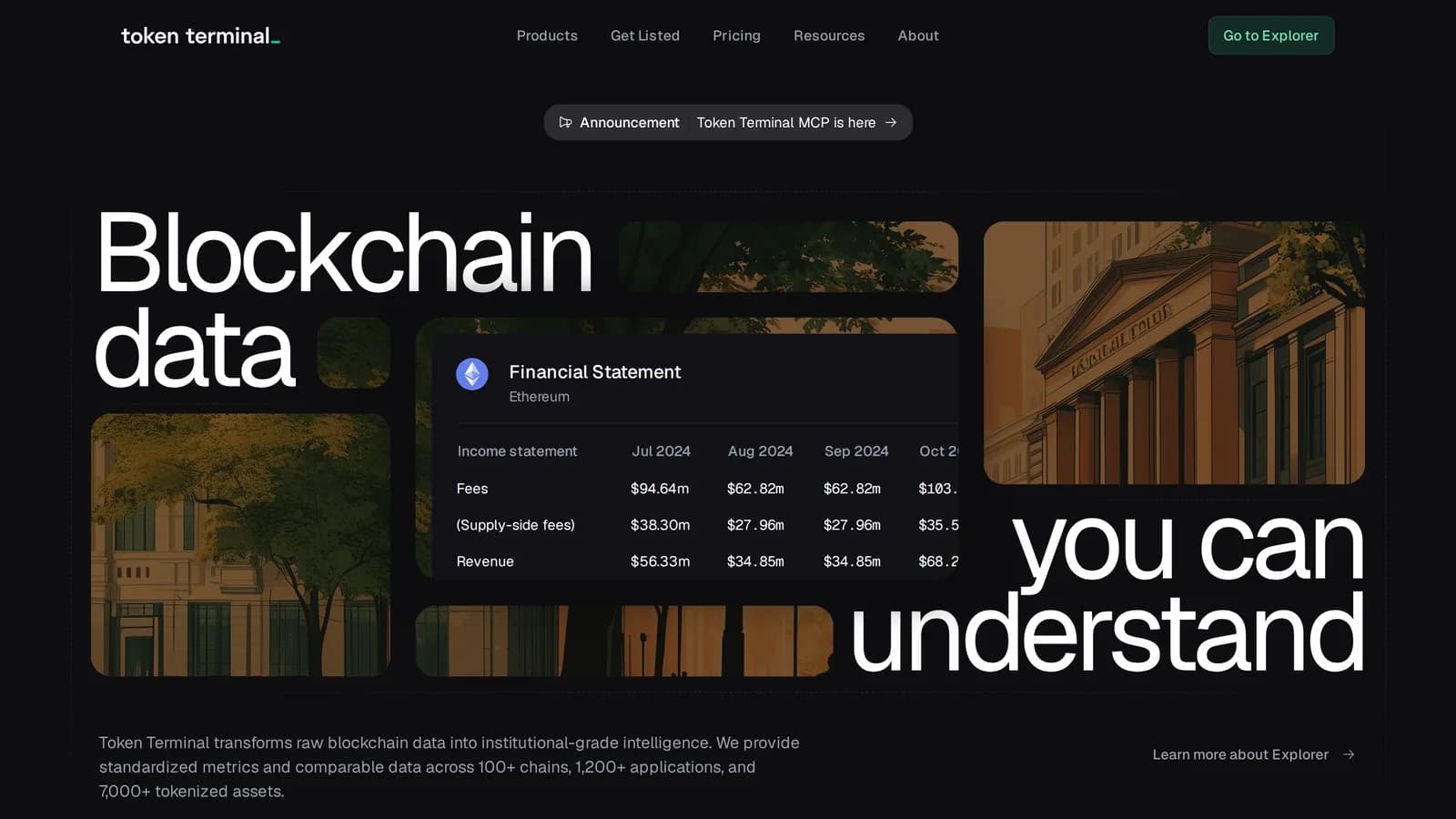
Applies conventional financial metrics — revenue, fees, earnings, multiples — to blockchain protocols, with documented methodology. The framing is both the value and the limitation: not every protocol's economics survive translation into a P&L.
- Best for
- Fundamental comparison of protocol economics
- Cost
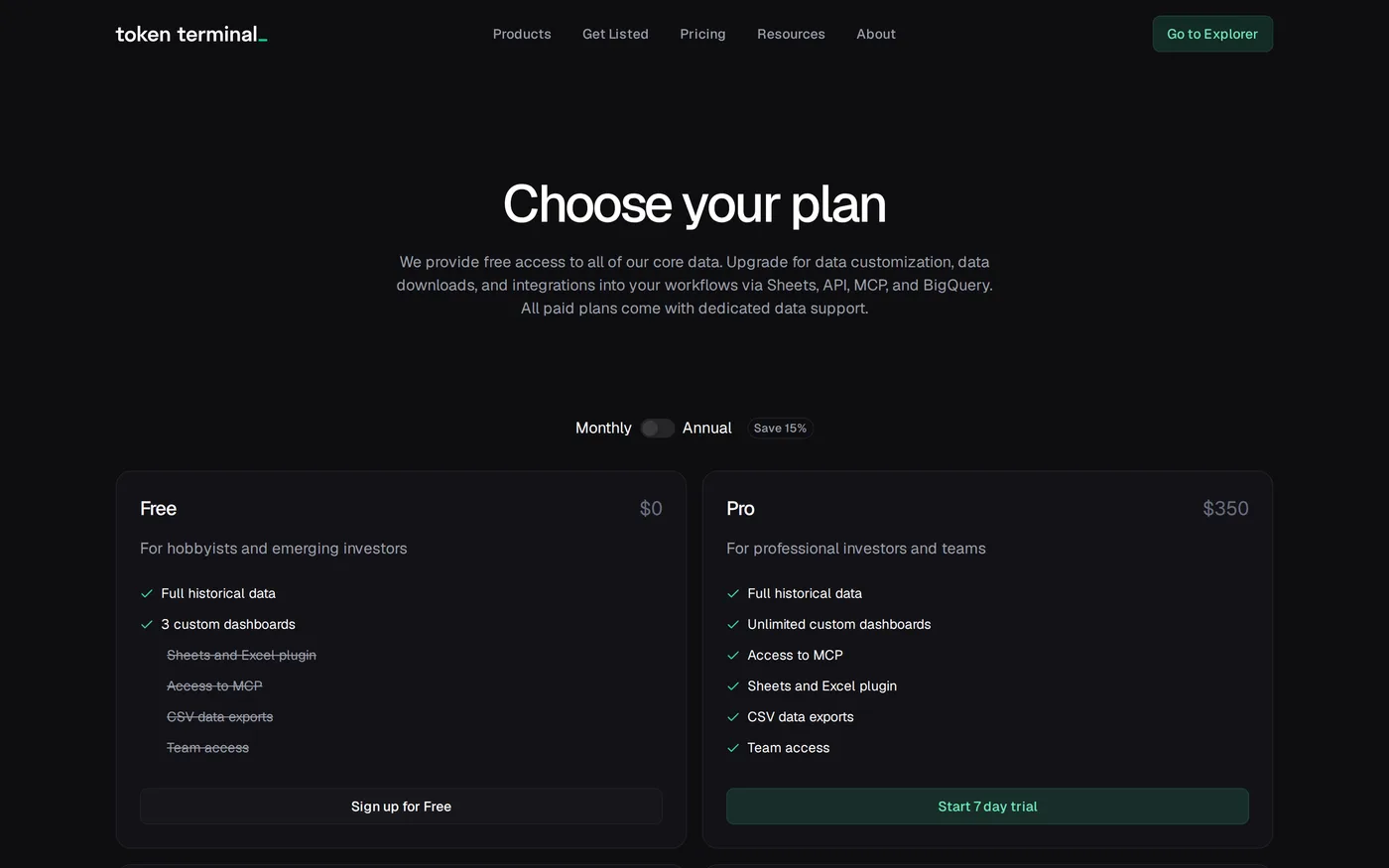
- Limited free tier; Pro quoted on request
What works
- Standardised revenue and fee definitions allow real cross-protocol comparison
- Methodology for each metric is published rather than asserted
- Multiples like price-to-fees give a valuation anchor beyond narrative
- Coverage includes chains, DeFi protocols and applications in one framework
What does not
- Most depth sits behind pricing quoted on request
- Traditional-finance framing does not fit every token's actual economics
- Revenue attribution between protocol, LPs and token holders is genuinely contested
- Thin coverage of newer or smaller protocols
For most of crypto's history, valuing a token meant comparing narratives and hoping yours was more persuasive. Token Terminal's premise is that a substantial number of protocols now have measurable economics — users pay fees, those fees go somewhere specific — and that this can be presented the way an equity analyst would present a company.
The definitions are the product
The hard part is not gathering the data. It is deciding what counts as what.
When a user pays a swap fee that goes to liquidity providers, is that protocol revenue? Token Terminal separates total fees from the share accruing to the protocol itself.
When a chain burns part of its transaction fee, is that revenue, a buyback, or neither?
When token emissions exceed fee income, what is the protocol's actual earnings figure, and should it be negative?
Every one of these is genuinely contestable, and the value of the site is that it answers them consistently and publishes the answer. Consistent definitions applied across protocols allow comparison; that is the entire point, and it is why an inconsistent competitor with more data would be less useful.
The multiples
Price-to-fees and similar ratios give an anchor that narrative-based valuation does not. A chain trading at an enormous multiple of the fees it collects is not necessarily overvalued — it may be early, and early-stage multiples look absurd in every asset class — but knowing the number changes the conversation from adjectives to arithmetic.
Used well, this is the antidote to the most common mistake in the market: buying a token because the technology is interesting, without ever asking what the token captures.
Where the framing breaks
Not every token is a claim on cash flows. Many governance tokens have no mechanism by which protocol revenue reaches holders at all — the protocol can earn substantially while the token captures precisely nothing.
A low price-to-fees ratio on such a token is not cheapness. It is a category error. The data is accurate and the inference is invalid, and that is a mistake the interface makes very easy to commit.
Protocol revenue is a fact about the protocol. Whether any of it reaches the token is a separate fact, and it is the one that decides whether the multiple means anything at all.
Coverage and pricing
Major chains and the larger DeFi protocols are covered well, with history deep enough to see how economics changed across cycles. Newer and smaller protocols are thin, which is the same limitation every research product in this category has and probably always will.
A limited free tier shows the shape of the data. Full access is quoted on request, which in practice means it is priced for funds rather than individuals.
Verdict
The questions it is genuinely good for
Is this chain's fee revenue growing, flat, or held up by a single application?
How much of this protocol's apparent activity survives the end of its incentive programme?
Which of these two competing protocols actually earns more per unit of TVL?
Has the market's valuation of this category changed, or only its narrative?
Those are hard questions to answer from a price chart and straightforward to answer here, which is the argument for the product in one line.
Fees versus revenue, the distinction that matters most
A DEX processing a billion dollars of volume generates large fees. Almost all of that goes to liquidity providers, who supplied the capital and bear the risk. The protocol itself may keep a fraction of a percent, or nothing at all.
Token Terminal separates these consistently, and the gap between the two numbers is frequently enormous. A headline about a protocol 'earning' a large sum is nearly always quoting total fees, and nearly always describes money that went to somebody other than the protocol or its token holders.
How to use it alongside DefiLlama
The two overlap and are complementary. DefiLlama is free, broader and better for TVL, yields and the long tail. Token Terminal is narrower, deeper on the income-statement framing, and more careful about attribution between protocol, providers and holders.
For most individuals, DefiLlama plus a spreadsheet covers what Token Terminal's paid tier provides. For an analyst who needs consistent definitions applied by somebody else and defensible to a third party, the subscription is doing real work.
Score: 7.6. A genuinely useful discipline imported into a market that needed it, executed with unusual methodological honesty. The score reflects the paywall and the real risk of applying an equity framework to assets that are not equity and were never designed to be.